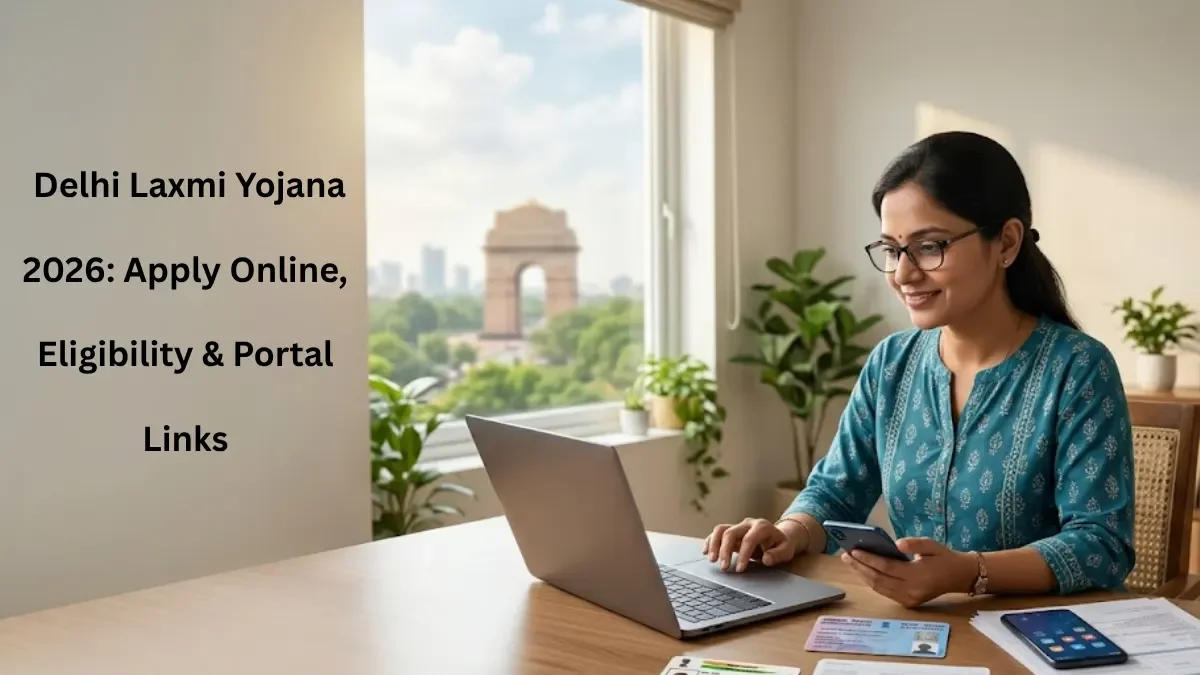
The Delhi Government is preparing to roll out its highly anticipated flagship welfare program, the Delhi Laxmi Yojana, on August 28, 2026, coinciding with the auspicious festival of Raksha Bandhan. Formerly structured during the budget planning phase as the Mahila Samriddhi Yojana, the initiative has been officially rebranded to give it a distinct identity closely tied to the national capital. The scheme aims to provide direct monthly financial assistance of ₹2,500 to economically disadvantaged women residing across Delhi.
This ambitious welfare rollout comes backed by a substantial budgetary allocation of ₹5,100 crore, which was locked in during the Delhi Budget presentation. Spearheaded by a high-level ministerial panel, final preparations are moving at a rapid pace to ensure that the initial financial disbursements can commence on schedule. The program represents one of the largest direct-benefit socio-economic security nets launched for women in the National Capital Territory (NCT).
A critical component of this rollout is the Delhi Laxmi Yojana Apply Portal, which has been completely developed by the government's IT division. The digital infrastructure is designed to handle mass registrations seamlessly, eliminating the need for long queues at government offices. Officials have confirmed that the portal is fully operational and is undergoing minor programmatic updates to reflect the final eligibility filters before it officially opens to the public for registrations.
Quick Facts: Delhi Laxmi Yojana 2026
Key Detail | Description |
Scheme Name | Delhi Laxmi Yojana (Rebranded from Mahila Samriddhi Yojana) |
State/UT | National Capital Territory of Delhi |
Monthly Assistance Amount | ₹2,500 per month (Paid via Direct Benefit Transfer / CBDC) |
Target Beneficiaries | Economically weaker women aged 21 to 60 years |
Annual Income Limit | Up to ₹2.5 Lakh to ₹3 Lakh (Final approval pending) |
Estimated Beneficiaries | 20 Lakh to 22 Lakh women |
Total Budget Allocated | ₹5,100 Crore |
Official Launch Date | August 28, 2026 (Raksha Bandhan) |
Application Mode | Online through the dedicated digital portal |
What Happened
The Department of Women and Child Development (WCD), in coordination with the IT Department of Delhi, has finalized the digital infrastructure for the Delhi Laxmi Yojana. This scheme will guarantee a monthly financial payment of ₹2,500 to underprivileged female residents. To ensure a completely transparent deployment, the state government is executing this rollout through an advanced web-based software application.
The ministerial committee overseeing the project is wrapping up formal consultations with primary banking partners to coordinate the transfer mechanics. The online portal is planned to go live by mid-August, giving eligible applicants a window to upload their information before the mass disbursement begins on August 28.
Background and Political Context
The deployment of a mass monthly cash transfer program for women has been a central focal point in Delhi's political landscape over the last year. The scheme traces its roots back to key election promises made during the 2025 Delhi Assembly polls. While preliminary outlines of the financial dole were drawn under the previous administration, the actual execution stalled due to structural disagreements and delays in mapping out the exact socio-economic filters.
Following a political shift, a specialized high-level committee was established to fast-track the program. With the finalization of the framework, the current administration is moving to cash in on this key promise, positioning the Delhi Laxmi Yojana as a pillar of gender-focused governance. By scaling this project up to cover over two million women, the government is looking to establish a robust social safety net that addresses urban poverty at the household level.
Timeline of Events
March 2025: An initial fiscal allocation of ₹5,100 crore is approved in the state budget under the title Mahila Samriddhi Yojana.
Late 2025: A high-level ministerial committee is organized to draft implementation norms and structural guidelines.
Mid 2026: The program is systematically renamed the Delhi Laxmi Yojana to create a distinct municipal identity.
July 2026: The IT Department completes testing on the online application portal.
Mid-August 2026 (Expected): The registration portal opens to accept incoming citizen data.
August 28, 2026: Official statewide rollout and initiation of the first monthly financial cycle.
Eligibility Criteria
While the high-level committee is putting the final touches on the fine print, the draft parameters establish clear boundaries to ensure that the funds reach those who need them most.
Who is Eligible?
Age Limit: The applicant must be a woman between 21 and 60 years of age.
Residency: Must be a verified permanent resident of the National Capital Territory of Delhi.
Economic Threshold: The annual family income of the applicant must not exceed ₹2.5 Lakh to ₹3 Lakh.
Ration Card Holders: Women from the 17 lakh households holding valid Delhi ration cards will receive priority processing, as their economic status has already been verified through extensive government drives.
Who is Excluded?
To optimize the utilization of state funds, specific categories have been strictly excluded from the beneficiary pool:
Women belonging to families where any member is a Government Employee or a regular pensioner.
Active Income-Tax Payers.
Individuals or households that own a four-wheeler motor vehicle.
How It Happened: The Tech Behind the Application Portal
The Delhi Government wanted to avoid the chaotic, paper-heavy processing cycles seen in historical welfare distributions. The newly built portal operates on an integrated digital framework that connects directly with foundational identity systems.
Applicants will log onto the central platform and submit a simple, unified form. The system uses secure Application Programming Interfaces (APIs) to cross-reference input parameters with national and state databases. For instance, entering an Aadhaar number instantly checks demographic data, while linking ration card numbers pulls pre-verified income records. This algorithmic validation allows the back-end system to approve or flag applications almost instantly, meaning a process that used to take months can now be finished in days.
Required Documents for Online Application
To ensure a smooth application experience once the portal goes live, applicants should keep digital copies of the following documents ready:
Aadhaar Card (Must be active and updated).
Proof of Residence in Delhi (Voter ID, electricity bill, or land documents).
Aadhaar-Linked Bank Account Details (Including clear copies of the passbook or a cancelled check displaying the IFSC code).
Income Certificate issued by a designated public authority (or a valid Ration Card).
A signed Self-Declaration Form verifying that the applicant does not own a four-wheeler or hold a government job.
Mode of Payment: Direct Transfers & Digital Rupee
The government is actively planning the most secure way to send out these monthly payments. The core mechanism will rely on the standard Direct Benefit Transfer (DBT) pipeline, which sends money straight into the beneficiary's Aadhaar-seeded bank account. However, two additional progressive options are currently being evaluated:
Fixed Deposit Allocation: The government is studying a model where a specific portion of the monthly aid is moved directly into a fixed deposit under the woman's name to foster long-term structural savings.
Central Bank Digital Currency (CBDC): In a major technological push, officials are discussing the use of the Digital Rupee issued by the Reserve Bank of India (RBI). If implemented, beneficiaries will use a specialized CBDC digital wallet to receive and spend their monthly financial aid.
Economic and Social Impact
The injection of ₹5,100 crore directly into the hands of low-income women is expected to have a notable local economic multiplier effect. Because lower-income households typically have a higher marginal propensity to consume, the majority of the ₹2,500 monthly transfers will go straight back into local markets for essential goods like food, healthcare, and education.
Socially, the program drives immediate financial independence. Providing direct capital to women improves their decision-making power within the family and secures household stability. It also prevents vulnerable families from falling into debt traps set by unorganized local moneylenders during financial emergencies.
Challenges in Implementation
Despite the advanced portal, the program faces a few operational hurdles:
The Digital Divide: A large percentage of the target demographic lacks smartphones or consistent internet access, which could slow down direct online registrations.
Bank Account Seeding: The DBT model requires a clear connection between a citizen's Aadhaar card and their active bank account. Resolving mismatched details remains a major administrative task.
Data Verification: Filtering out ineligible applicants among the millions of submissions will require seamless cooperation across multiple government departments.
Key Highlights
Fixed Monthly Stipend: Low-income women in Delhi will receive an assured payment of ₹2,500 every month.
Mass Target Audience: The program is estimated to support between 20 lakh and 22 lakh women across the capital.
Launch Date Set: The official launch is scheduled for August 28, 2026, on Raksha Bandhan.
Fully Online Registration: Applications will be processed through a newly engineered web portal to maximize speed and minimize corruption.
Advanced Payment Tech: The administration is exploring modern payment paths, including the RBI's Digital Rupee (CBDC).