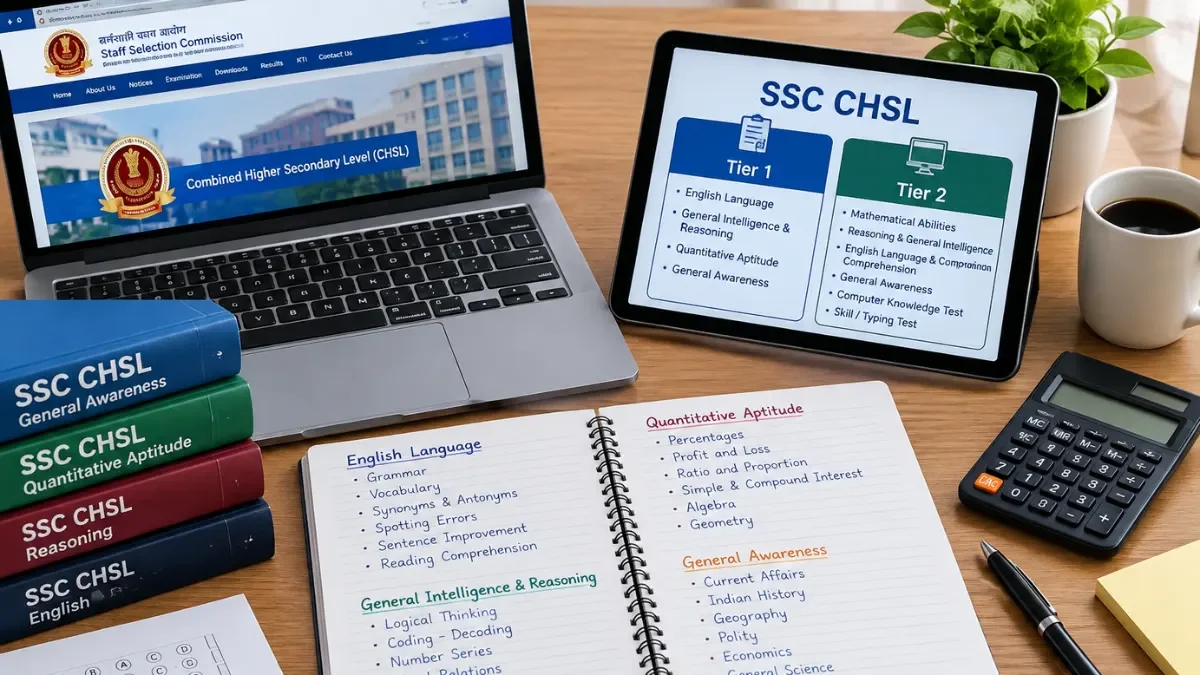
The Staff Selection Commission (SSC) conducts the Combined Higher Secondary Level (CHSL) examination annually to recruit eligible candidates for various posts such as Lower Division Clerk (LDC), Junior Secretariat Assistant (JSA), and Data Entry Operators (DEOs) across various ministries and government departments. Understanding the official syllabus and exam structure is the crucial first step for lakhs of aspirants preparing for the competitive tests.
The recruitment process is broadly divided into two main stages: Tier 1 and Tier 2. Each stage tests different skill sets, requiring aspirants to adopt a structured and focused study plan.
SSC CHSL Tier 1 Syllabus and Exam Structure
Tier 1 is a computer-based objective examination designed for shortlisting candidates. It comprises 100 multiple-choice questions carrying a total of 200 marks, to be completed within a strict time limit of 60 minutes. There is a negative marking of 0.50 marks for every incorrect answer.
The Tier 1 exam is divided into four equal sections of 25 questions each:
English Language: Focuses on basic grammar, vocabulary, synonyms, antonyms, spotting errors, sentence improvement, and reading comprehension.
General Intelligence & Reasoning: Tests logical thinking, coding-decoding, number series, blood relations, and non-verbal puzzles.
Quantitative Aptitude: Covers arithmetic fundamentals such as percentages, profit and loss, ratio and proportion, simple and compound interest, alongside basic algebra and geometry.
General Awareness: Evaluates knowledge of current affairs, Indian history, geography, polity, economics, and general science.
SSC CHSL Tier 2 Syllabus and Exam Structure
Candidates who clear Tier 1 advance to Tier 2, which determines the final merit list. Unlike earlier formats, Tier 2 includes objective computer-based tests, a mandatory computer knowledge module, and skill or typing tests tailored to specific job roles.
Section I of Tier 2 includes Mathematical Abilities and Reasoning and General Intelligence, while Section II covers English Language and Comprehension along with General Awareness. Additionally, candidates must pass a qualifying Computer Knowledge Test and a post-specific Skill Test or Typing Test to secure final placement.
Preparation Strategy and Why It Matters
A common mistake among aspirants is preparing for Tier 1 and Tier 2 in isolation. Because Tier 2 builds directly upon the foundational concepts learned for Tier 1—adding advanced problem-solving, data interpretation, and computer basics—a unified study approach is essential. Regular mock tests, time management drills, and thorough revision of core arithmetic and grammar rules will significantly boost accuracy and speed.
With government vacancies drawing immense competition, mastering the detailed syllabus enables candidates to identify high-weightage areas and optimize their daily study schedules effectively.