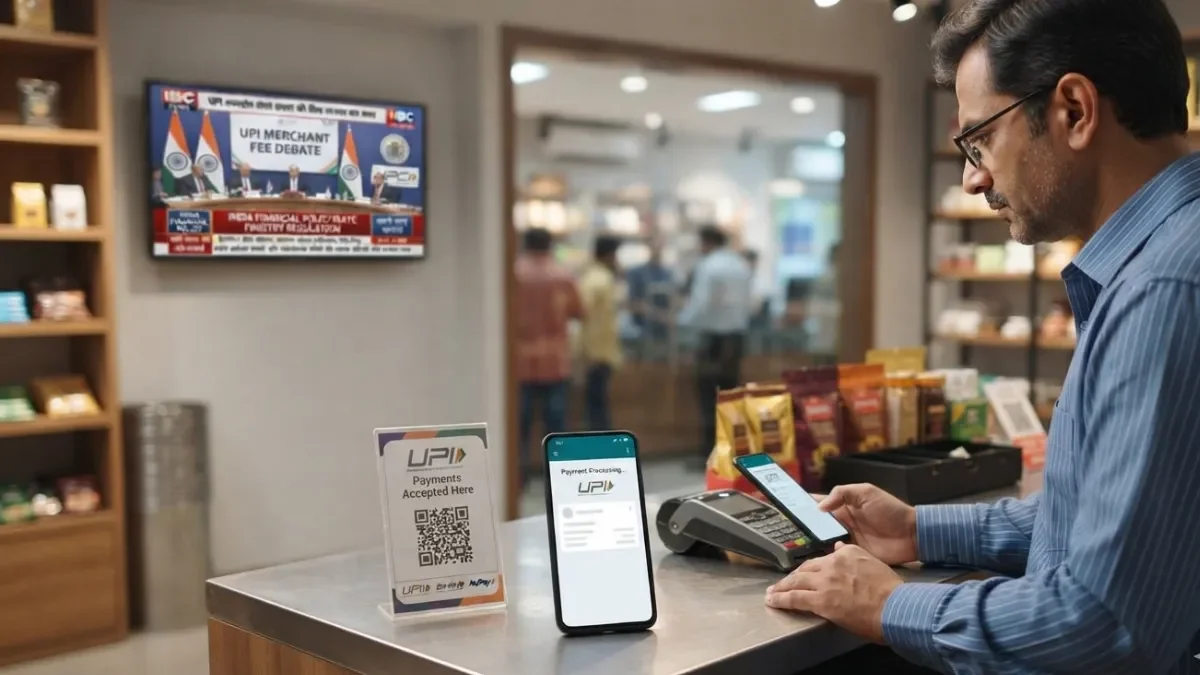
India’s new UPI merchant fee framework has triggered political opposition after the government announced a 0.4% Merchant Discount Rate (MDR) on specified person-to-merchant payments above ₹2,000. The new framework is scheduled to take effect from October 15, 2026.
The government has clarified that consumers will not be charged MDR and that person-to-person UPI payments will remain free. Opposition leaders, however, have criticised the move and questioned its potential impact on merchants and digital payments.
What is the new UPI merchant fee?
Under the new framework, a 0.4% MDR will apply to specified UPI payments made to merchants when the transaction value is above ₹2,000.
MDR is a fee within the payment ecosystem rather than a direct charge imposed on the customer. According to the Finance Ministry, the money is distributed among participating banks, payment service providers and UPI application providers to support the operation and expansion of the payment infrastructure.
For transactions of ₹75,000 or more, the 0.4% MDR will be capped at ₹300 per transaction.
Will customers have to pay UPI charges?
No, not under the new MDR framework.
The government has specifically stated that customers will not be required to pay MDR when making UPI payments. Banks have also been advised to ensure that merchants do not pass the MDR cost directly on to customers.
Person-to-person transactions will remain free regardless of the amount transferred.
For example, if someone sends ₹5,000 to a friend through UPI, the new merchant MDR does not apply.
Which UPI payments will attract the 0.4% MDR?
The 0.4% rate applies to specified person-to-merchant (P2M) transactions above ₹2,000.
| UPI transaction | New MDR treatment |
|---|---|
| Person-to-person payment | Free |
| Merchant payment up to ₹2,000 | Free |
| Specified merchant payment above ₹2,000 | 0.4% MDR |
| Merchant transaction ₹75,000+ | 0.4%, capped at ₹300 |
| Small merchants covered by zero-MDR framework | Free |
| Capital-market transactions | 0.02%, capped at ₹300 |
The framework also provides separate treatment for certain essential and thin-margin sectors. Transactions above ₹2,000 involving sectors such as railways, telecommunications, insurance, fuel and agricultural inputs will attract a flat ₹5 MDR.
Why are opposition parties opposing the new UPI fee?
Opposition leaders have criticised the introduction of MDR despite the government's clarification that customers will not directly pay the charge.
Congress leaders have argued that merchants could ultimately attempt to recover the additional cost from customers. Opposition representatives have also raised concerns that the new cost could discourage some businesses from accepting digital payments.
Some opposition statements have also connected the policy to alleged external pressure. The Finance Ministry has rejected those allegations, saying India's digital-payment policy decisions are made independently and that the MDR framework is intended to support the long-term sustainability of the UPI ecosystem.
These are competing political claims, rather than established facts about the government's motivation.
What has the government said about the new UPI rule?
The government says the framework is intended to create a more sustainable financial model for UPI while protecting ordinary users and small merchants.
According to the Finance Ministry, around 96% of merchant transactions will remain unaffected, because they either fall below the ₹2,000 threshold or are covered by the zero-MDR provisions for small merchants.
The government has also said that the MDR is not a tax and is not collected by the government or NPCI. Instead, it is distributed among participants in the payment ecosystem.
Will small merchants have to pay the new UPI fee?
Not all small merchants will be affected.
The new framework provides zero-MDR protection for eligible small merchants receiving up to ₹1 lakh per month through UPI QR codes under the P2PM category. This provision is intended to protect street vendors, neighbourhood shops and other small businesses from additional payment costs.
However, retailer organisations have raised concerns that the threshold may not adequately cover all small and medium businesses.
The Retailers Association of India and other industry groups have argued that the additional cost could be difficult for businesses operating on narrow margins, particularly during the upcoming festive shopping season.
When will the new UPI MDR rules start?
The new framework is scheduled to come into effect from October 15, 2026.
The announcement follows the government's earlier move to create an enabling framework for introducing MDR on a limited set of merchant transactions. NPCI subsequently announced the detailed rates and categories.
How much would 0.4% MDR be?
The calculation is straightforward.
For a qualifying merchant payment of ₹10,000, 0.4% would equal ₹40.
For a qualifying payment of ₹50,000, it would equal ₹200.
For a transaction of ₹75,000, 0.4% would equal ₹300, which is also the stated maximum MDR for transactions at or above that amount.
Importantly, these amounts describe the merchant-side MDR, not an additional fee that the customer is supposed to pay at checkout.
What happens to UPI payments below ₹2,000?
UPI merchant payments of ₹2,000 or less remain free of MDR under the new framework.
This means a customer paying ₹500 at a shop, ₹1,200 at a restaurant or ₹2,000 to an eligible merchant will not incur the new MDR.
The government says the threshold-based system is designed to keep the vast majority of smaller merchant transactions unaffected.
Are person-to-person UPI payments still free?
Yes.
The new MDR framework does not apply to person-to-person transactions. Sending money to family members, friends or another individual through UPI remains free irrespective of the transaction amount.
This distinction is important because the new policy is specifically focused on parts of the merchant payment ecosystem, rather than all UPI transactions.
Why is the government introducing MDR now?
The government says UPI needs a sustainable financial model as transaction volumes and the infrastructure supporting the system continue to grow.
The Finance Ministry has pointed to expenses associated with cybersecurity, fraud prevention, infrastructure upgrades and technological development as reasons for creating a revenue model for the ecosystem.
The government has also said the framework is intended to support continued expansion of UPI, including in rural and semi-urban areas.
Could the new fee affect digital payments?
Industry groups and some businesses have raised concerns that additional merchant costs could influence payment preferences.
Reuters reported that retailer organisations and financial brokers have opposed the new fee, with some warning that businesses could reconsider UPI usage because of the additional cost. The report also noted concerns about the timing of the change ahead of the festival shopping season.
Whether the policy changes consumer or merchant behaviour significantly will depend on how businesses implement the new framework after October 15.
What about UPI payments for stocks and mutual funds?
The new framework includes a separate MDR rate for capital-market transactions.
Payments involving mutual funds, securities, stockbrokers and dealers will attract an MDR of 0.02%, capped at ₹300 per transaction, according to the Finance Ministry.
This is separate from the standard 0.4% rate applicable to specified merchant transactions above ₹2,000.
UPI New Charges 2026: Key Points
- New MDR framework begins October 15, 2026.
- Specified merchant payments above ₹2,000 attract 0.4% MDR.
- MDR is a merchant-side payment ecosystem fee, not a consumer transaction charge.
- MDR is capped at ₹300 for transactions of ₹75,000 and above.
- Person-to-person UPI payments remain free.
- Merchant payments up to ₹2,000 remain free of MDR.
- Eligible small merchants receiving up to ₹1 lakh per month through specified UPI QR transactions remain protected under the zero-MDR framework.
- Opposition parties and industry bodies have raised concerns about the potential impact on merchants and digital-payment adoption.
- The government says the framework is intended to support UPI's long-term sustainability.
What does the new UPI fee mean for ordinary users?
For most everyday users, the immediate change is limited because customers are not supposed to pay the MDR.
Someone sending money to another person will continue to use UPI without a transaction charge. Similarly, merchant payments up to ₹2,000 remain outside the new MDR framework.
The bigger change is on the merchant side for qualifying payments above ₹2,000. The political and industry debate is now focused on whether those costs could influence merchant behaviour or eventually affect the wider digital-payment ecosystem.
FAQs
Is UPI becoming chargeable from October 15, 2026?
The new MDR framework introduces charges for specified merchant transactions above ₹2,000, but customers themselves are not supposed to be charged MDR. Person-to-person UPI payments remain free.
Is the 0.4% UPI charge paid by customers?
No. The 0.4% MDR is a merchant-side charge within the payment ecosystem. The government has directed that it should not be passed on to customers as a UPI charge.
Will UPI payments below ₹2,000 remain free?
Yes. Merchant UPI payments up to ₹2,000 remain free of MDR under the new framework.
Why are opposition parties objecting to the new UPI fee?
Opposition leaders have raised concerns that the additional merchant cost could ultimately affect customers or discourage some businesses from using digital payments. The government disputes the characterisation of MDR as a consumer tax or charge.