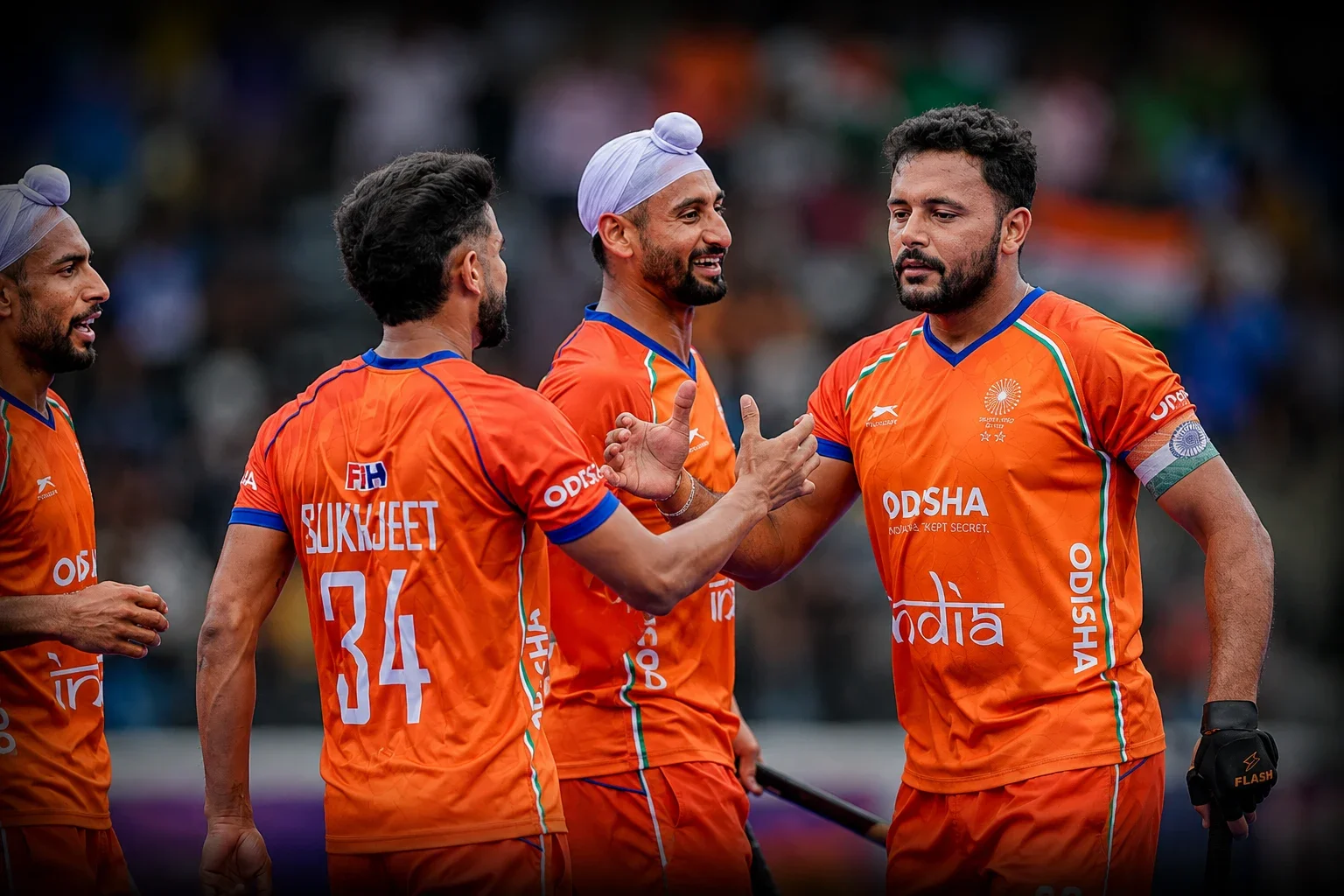
The Indian men's hockey team launched their 2026 FIH Men’s Hockey World Cup campaign with a clinical performance, as India beat Wales 3-1 in their opening Pool D fixture at the iconic Wagener Stadium in Amstelveen. Spearheaded by a decisive brace from skipper Harmanpreet Singh and an early penalty-corner strike from young drag-flicker Sanjay, the Indian side collected three vital tournament points to jumpstart their quest for international glory.
Controlled, methodical, and dominant in set-piece situations, the India hockey team dictated the tempo across all four quarters. The fixture served as a testament to India’s formidable depth in dead-ball execution, with head coach Craig Fulton’s tactical blueprint on full display. Yet beyond the action on the pitch, the opening clash between India and Wales in the Hockey World Cup 2026 highlighted a compelling narrative of two completely contrasting hockey ecosystems.
India vs Wales: A Battle Beyond the Scoreboard
While the scoreboard read India 3-1 Wales at the final whistle, the fixture presented a stark contrast long before the teams stepped onto the turf.
The Wales hockey team arrived at their second successive World Cup after turning to public generosity to finance their participation. Faced with operating on an estimated £100,000 annual deficit, Hockey Wales launched an online crowdfunding drive with a target of £40,000 (approximately Rs 51.8 lakh) to cover basic logistics, accommodation, high-performance camps, and travel. When the match got underway, the crowdfunded Wales hockey team was still shy of its ultimate target, relying on donations ranging from £10 to £100 alongside small corporate sponsorships.
For Welsh internationals, representing their country regularly comes with a personal price tag. Players contribute roughly £1,200 annually out of their own pockets toward kit, travel, and accommodation simply to wear the national colours.
In contrast, India’s preparation reflected the strength of a fully funded, centrally backed national sports ecosystem. Fulton’s squad spent the preceding year in rigorous residential camps, supported by sports science, nutrition, foreign exposure tours, and government funding through the Target Olympic Podium Scheme (TOPS) and long-term sponsorships. The disparity in resources was vast, yet on the turf, the Welsh side fought with grit and tactical discipline.
How India Sealed the 3-1 Victory
India’s strategy revolved around exploiting set pieces and maintaining territorial possession, while snuffing out Welsh counter-attacks.
Sanjay Breaks the Deadlock
India wasted little time establishing control. In the 8th minute, sharp interchange between midfielder Hardik Singh and forward Shilanand Lakra inside the circle earned India their first penalty corner. With primary flicker Harmanpreet Singh off the pitch during rotation, 25-year-old Sanjay stepped up to the battery. Exhibiting composure, Sanjay unleashed a crisp, low drag-flick that slipped cleanly between the pads of Welsh goalkeeper Toby Reynolds-Cotterill to hand India a 1-0 lead.
Harmanpreet Singh's Double Strike
As the match progressed, India's talismanic captain showcased his status as one of the world's most feared drag-flickers.
- First Goal: Early in the second half, India earned another penalty corner through aggressive wing play. Harmanpreet Singh stepped up and drove an unstoppable shot into the top corner, doubling India's advantage and deflating the Welsh defensive structure.
- Second Goal: Minutes later, the Indian skipper struck again from another penalty-corner variation, beating the first rusher and finding the bottom corner with pinpoint precision to make it 3-0.
Wales Fight Back with Late Consolation
To their credit, Wales refused to surrender. Boasting high-calibre internationals such as captain Jacob Draper and drag-flick specialist Gareth Furlong—both seasoned campaigners who represented Great Britain at the Paris Olympics—Wales tested India’s defensive cordon during the fourth quarter.
Their persistence paid off in the closing stages when a swift circular entry culminated in a well-worked field goal, beating the Indian goalkeeper to reduce the deficit to 3-1. Despite the late concession, India's deep defensive line and defensive midfielders comfortably managed the remaining minutes to close out the match.
What India’s Win Means for the Hockey World Cup
Securing three points in the opening game gives the India Hockey World Cup campaign critical early momentum in India Pool D. In a tournament format where goal difference and direct pool victories determine automatic quarterfinal qualification, starting with a multi-goal triumph is essential.
However, the road ahead steepens considerably for Fulton's men. India next face a high-stakes encounter against European heavyweights England, followed by a clash against traditional rivals Pakistan.
The upcoming battle against England on August 17 will serve as a true benchmark for India's tactical discipline and penalty-corner conversion efficiency under pressure. While the fixture against Wales allowed India to rotate players and build on-field chemistry, maintaining defensive sharpness will be paramount when facing faster, higher-ranked attacking units.
Read More: Who Is Ashish Yadav? The Indian Javelin Thrower Behind a Historic U20 Medal
A Respectable Display on the World Stage
The India vs Wales Hockey World Cup 2026 opener will be remembered not only as a successful first hurdle cleared by the Men in Blue, but also as a demonstration of resilience by Wales.
Ranked 15th in the world, the Welsh team showcased that passion, tactical cohesion, and elite international experience can keep a side competitive against one of world hockey’s traditional superpowers, regardless of financial barriers. As the tournament unfolds across Belgium and the Netherlands, India beat Wales to lay down an early marker in their pool, while Wales proved once again that their place on the grandest stage of world hockey is thoroughly deserved.