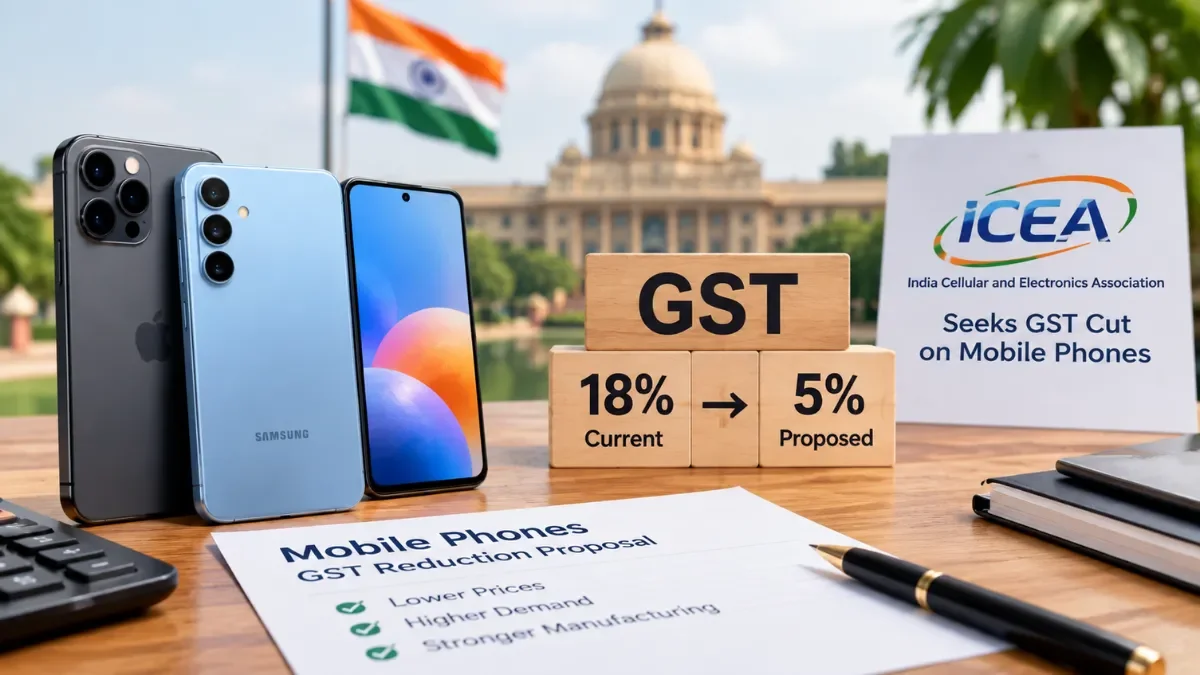
Mobile phones could become cheaper if a new industry proposal to reduce GST is accepted by the government. The India Cellular and Electronics Association (ICEA) has asked the Centre to cut the GST rate on mobile phones from the current 18% to 5%, arguing that weaker domestic demand and sharply higher memory-chip costs are putting pressure on smartphone affordability.
ICEA made the request in representations to Finance Minister Nirmala Sitharaman and Electronics and IT Minister Ashwini Vaishnaw dated September 2 and September 3, 2026. The association wants the proposal to be considered by the GST Council.
Why is ICEA asking for a mobile phone GST cut?
The industry's argument comes at a difficult time for India's smartphone market. ICEA says domestic consumption has weakened, replacement cycles have become longer and affordable smartphones are facing increasing price pressure.
At the same time, memory components used in smartphones have become substantially more expensive. According to ICEA, mobile DRAM and NAND flash prices have increased roughly fourfold since September 2025, partly because AI data centres are consuming a large share of global memory capacity.
The association argues that lowering GST could help reduce the affordability barrier for consumers while supporting demand for smartphones.
What GST rate does ICEA want for mobile phones?
ICEA wants the GST rate on mobile phones to fall from 18% to 5%.
| Particular | Current | ICEA proposal |
|---|---|---|
| GST on mobile phones | 18% | 5% |
| Proposed reduction | — | 13 percentage points |
| GST reduction relative to current rate | — | About 72% |
The proposal would apply a much lower tax rate to mobile phones than the current standard rate. However, the proposal has not been approved, so consumers should not assume that phone prices will immediately fall.
Mobile phones under tariff heading 8517 are currently included in the 18% GST category in GST Council documentation.
How much could a phone become cheaper if GST falls to 5%?
The potential difference can be illustrated with a simple example.
Suppose a smartphone has a pre-GST price of ₹20,000. At 18% GST, the tax component would be ₹3,600, taking the total to ₹23,600.
If GST were reduced to 5%, the tax would become ₹1,000 and the total would be ₹21,000, assuming the entire tax reduction is passed on to the consumer.
| Example | 18% GST | 5% GST |
|---|---|---|
| Pre-GST price | ₹20,000 | ₹20,000 |
| GST | ₹3,600 | ₹1,000 |
| Final price | ₹23,600 | ₹21,000 |
| Difference | — | ₹2,600 |
This is only an illustration. The actual retail price reduction would depend on manufacturers, distributors and retailers passing the tax saving through to buyers.
Why are smartphone prices rising?
ICEA has linked the recent affordability problem to higher component costs, particularly memory.
The association says entry-level smartphone prices have increased by around 35% to 45% across brands over the past year. It also says the supply of smartphones priced below ₹10,000 has contracted sharply, with that segment accounting for less than 5% of supply.
That is significant because budget smartphones are often the entry point for first-time users and people moving from feature phones to smartphones.
If those devices become more expensive, consumers may delay upgrading or continue using older devices for longer.
Is India's smartphone market slowing down?
Industry data cited in the latest reports points to weaker demand.
Market research estimates cited by ET ElectronicsWorld suggest India's smartphone shipment volume could decline by around 8% to 15% in calendar 2026, potentially reaching about 136–138 million units.
ICEA is therefore presenting the GST reduction as a demand-support measure rather than simply a tax concession for manufacturers.
The association's argument is that lower taxation could make phones more affordable, encourage upgrades and potentially expand the formal market.
Why does ICEA say the GST cut could help the government too?
A lower GST rate does not automatically mean government revenue will fall by the same proportion.
ICEA has argued that a reduction in the tax rate could stimulate enough additional sales to partly offset the lower tax collected per handset. More formal-market purchases could also increase the overall taxable base.
However, this is an industry argument, not a confirmed government revenue forecast. The eventual impact would depend on how much demand responds to lower prices and how much of the tax reduction reaches consumers.
Has ICEA asked for GST relief on mobile components too?
Yes.
Alongside the proposed handset GST reduction, ICEA has sought GST rate rationalisation for mobile-phone components.
This is connected to India's broader effort to move from simply assembling smartphones toward producing a larger share of high-value components domestically.
India now assembles the overwhelming majority of mobile phones sold domestically, but local value addition remains much lower because several important components are still imported.
Why is this important for India's electronics manufacturing ambitions?
India has become a major global mobile-phone manufacturing and export base.
The next challenge is to increase domestic production of components such as printed circuit boards, displays, camera modules and other high-value parts. The government has introduced the Electronics Components Manufacturing Scheme (ECMS) to encourage this deeper manufacturing ecosystem.
ICEA's latest GST request therefore comes alongside a much larger policy discussion about affordability, domestic manufacturing and India's position in the global electronics supply chain.
Could cheaper smartphones boost digital access?
Potentially, particularly at the lower end of the market.
Affordable smartphones are used for digital payments, online education, government services, communication, banking and access to the internet. If handset prices rise significantly, some consumers may postpone their first smartphone purchase or delay replacing an older device.
ICEA's argument is that a lower GST rate could make smartphones more accessible to price-sensitive consumers while helping the industry recover domestic demand.
However, the final effect would depend on the size of the tax reduction actually passed through to consumers.
Will all smartphones become cheaper if the GST cut is approved?
Not necessarily by the same amount.
A tax reduction would lower the GST component, but manufacturers may also be dealing with higher memory, display, semiconductor and other component costs. Companies could use some of the savings to absorb rising input costs rather than reduce the full retail price.
Premium smartphones may also see a different impact from budget models because their pricing is influenced by several factors beyond GST.
The biggest affordability impact could potentially be seen in lower-priced devices, where even a modest reduction in the final price can influence purchasing decisions.
What happens next?
The proposal now needs to go through the government's GST decision-making process.
ICEA has asked the Finance Ministry and Electronics and IT Ministry to take up the matter at the next GST Council meeting. Until the Council considers and approves any change, the 18% GST rate remains applicable.
Consumers therefore should not delay or accelerate a purchase solely because of reports of a possible GST reduction.
Mobile Phone GST Cut: What consumers should know
| Question | Answer |
|---|---|
| Current GST on mobile phones | 18% |
| ICEA's proposed rate | 5% |
| Who made the request? | India Cellular and Electronics Association |
| Why the demand? | Weak demand, longer replacement cycles and higher component costs |
| Has the cut been approved? | No |
| Could phones become cheaper? | Potentially, if the proposal is approved and savings are passed on |
| Are components also part of the proposal? | ICEA has sought GST rate rationalisation for components |
What could a GST cut mean for buyers?
If approved and fully passed through, a lower GST rate would reduce the tax-inclusive price of smartphones.
For example, a phone with a ₹30,000 pre-GST price would currently cost ₹35,400 at 18% GST. At 5% GST, the same base price would result in a ₹31,500 final price — a theoretical difference of ₹3,900.
But this should not be interpreted as a guaranteed future retail price. Manufacturers could face higher component costs, and the final benefit would depend on pricing decisions across the supply chain.
What could it mean for smartphone manufacturers?
Manufacturers could benefit from stronger domestic demand if lower taxes make devices more affordable.
The move could also help brands operating in the entry-level and mid-range segments, where consumers are particularly sensitive to price increases.
For India's electronics industry, stronger domestic consumption would complement the country's rapidly growing export and manufacturing activity.
Quick answer: Mobile Phone GST Cut
What GST rate is ICEA asking for?
ICEA wants GST on mobile phones reduced from 18% to 5%.
Has the government approved the GST cut?
No. The proposal has been submitted to the government and would need to go through the GST Council process.
Why does ICEA want the rate reduced?
The association says domestic demand has weakened while memory-chip prices and smartphone costs have increased.
Will phones immediately become cheaper?
No. Prices will not change because of the proposal alone. Any reduction would depend on government approval and how much of the tax saving is passed to consumers.
FAQ
What is the current GST on mobile phones in India?
Mobile phones under the relevant 8517 classification are currently subject to 18% GST.
Who has demanded a GST cut on mobile phones?
The India Cellular and Electronics Association (ICEA) has asked the government to reduce the rate.
What GST rate does ICEA want?
ICEA has proposed reducing GST from 18% to 5%.
Will iPhone and Samsung phones become cheaper?
They could become cheaper if the proposal is approved and the tax saving is passed on, but there is currently no approved price cut.