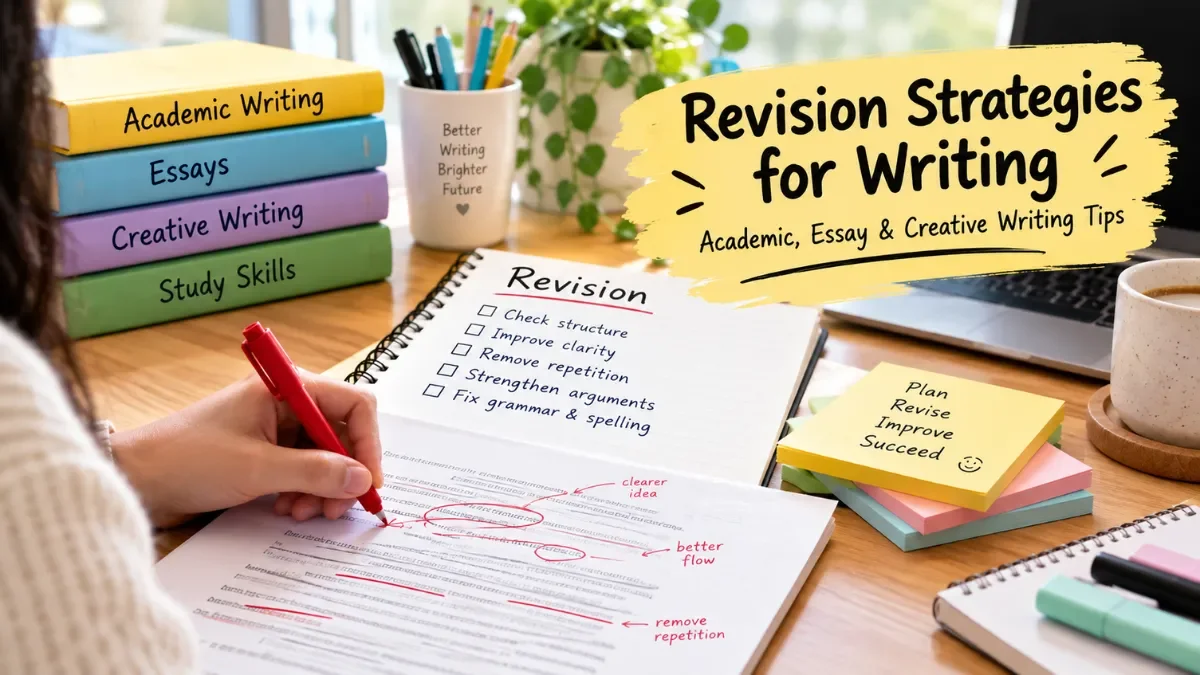
Whether you are revising an academic assignment, essay, paragraph or creative story, effective revision involves more than checking spelling mistakes. It means looking at the writing as a whole and deciding what needs to be changed, removed, expanded or reorganised.
Why Is Revision Important in the Writing Process?
Revision is important because a first draft rarely represents the strongest version of an idea. Writers often discover better arguments, clearer explanations or stronger ways of organising information after they have finished the initial draft.
Revision can help you:
- Make your main argument clearer
- Improve the organisation of ideas
- Remove unnecessary information
- Add missing explanations or evidence
- Improve paragraph structure
- Make sentences easier to understand
- Strengthen transitions between ideas
- Improve the tone for the intended audience
- Correct inconsistencies in the writing
For academic work, revision is particularly important because a well-written assignment needs to communicate ideas logically and support claims with appropriate evidence.
What Are Revision Strategies for Writing?
Revision strategies are specific methods writers use to evaluate and improve a draft. Instead of reading the entire piece repeatedly without a plan, you can use different strategies to focus on particular aspects of your writing.
Some useful revision strategies include:
- Reading the draft for the overall argument
- Checking the structure and organisation
- Reviewing each paragraph's main idea
- Looking for unsupported claims
- Removing repetition
- Improving unclear sentences
- Checking transitions
- Reading the work aloud
- Getting feedback from another reader
- Proofreading only after the larger revisions are complete
The key is to revise in stages rather than trying to fix everything at the same time.
What Are the Best Revision Strategies for Students?
Students can make revision more manageable by separating content revision from proofreading.
1. Check the assignment question
Before changing your writing, return to the original question or assignment instructions.
Ask:
- Have I answered the question?
- Is my main argument clear?
- Have I covered all required points?
- Is every section relevant?
- Have I followed the required format?
A grammatically perfect essay can still be ineffective if it does not answer the assignment question.
2. Identify your main argument
Read your introduction and conclusion separately.
Your introduction should establish what the assignment is about and, where appropriate, present your central argument or purpose. Your conclusion should bring the main discussion together rather than introducing a completely new argument.
If you cannot identify the main point of your essay after reading it, the argument may need revision.
3. Check the order of ideas
Look at each paragraph and ask whether it appears in the most logical position.
Sometimes an essay contains good ideas but presents them in an order that makes the discussion difficult to follow. Moving a paragraph or combining two related sections can improve the overall structure without requiring a complete rewrite.
4. Check your evidence
Academic writing often depends on evidence to support important claims.
During revision, check whether:
- Evidence actually supports the point being made
- Sources are relevant to the argument
- Important claims need additional evidence
- Evidence has been explained rather than simply inserted
- Different sources are being connected effectively
5. Remove unnecessary information
Revision is not always about adding more content.
If a sentence repeats something already explained, does not support the main argument or moves away from the topic, consider removing it.
Concise writing is often easier to understand than writing that contains unnecessary repetition.
What Are Revision Strategies for Essays?
Essay revision works best when you move from large issues to small issues.
Start with the argument and structure before checking individual sentences.
A useful essay revision sequence
Step 1: Review the thesis or central argument
Does it clearly communicate what the essay is trying to establish?
Step 2: Review the introduction
Does the introduction provide enough context and prepare the reader for the discussion?
Step 3: Review the body paragraphs
Does each paragraph contribute to the main argument?
Step 4: Review the evidence
Are important claims supported and explained?
Step 5: Review transitions
Can the reader understand how one idea connects to the next?
Step 6: Review the conclusion
Does the conclusion bring the discussion together?
Step 7: Edit sentences
Only after the larger changes are complete should you focus heavily on wording, grammar and punctuation.
How Do You Revise a Paragraph?
A simple way to revise a paragraph is to examine five elements:
Topic sentence → Evidence → Explanation → Connection → Closing/transition
Start by identifying the paragraph's main point.
Then ask whether every sentence supports that point.
Example of revising a paragraph
Before revision:
Social media is popular among students. Many students use social media every day. It can help students communicate with their friends. Students can also find information online. However, social media can sometimes distract students from studying. Therefore, students should be careful when using social media.
The paragraph communicates a basic idea, but several sentences repeat the same point and the relationship between the ideas could be clearer.
After revision:
Social media can support students' communication and access to information, but excessive use may interfere with academic work. Students can use online platforms to communicate with classmates, exchange resources and discover educational material. However, frequent notifications and unrelated content can also interrupt concentration during study sessions. For this reason, students may benefit from setting clear boundaries around social media use while completing academic tasks.
The revised version has a clearer central idea, stronger connections between sentences and less repetition.
What Are the Different Types of Revision in Writing?
Revision can take place at several levels. Understanding these levels can help writers know what to focus on.
1. Global revision
Global revision looks at the entire piece of writing.
It includes questions about:
- Purpose
- Main argument
- Organisation
- Structure
- Audience
- Overall effectiveness
For example, you might realise that your essay's strongest argument appears in the final section and decide to reorganise the earlier paragraphs around it.
2. Section-level revision
This focuses on individual sections or groups of paragraphs.
You might combine two sections that discuss the same idea, move a section to a more logical position or add information where the discussion is incomplete.
3. Paragraph-level revision
Paragraph revision examines how individual paragraphs work.
You can check whether each paragraph has a clear purpose, whether the sentences remain focused and whether the paragraph connects to the overall argument.
4. Sentence-level revision
At this stage, you examine individual sentences for clarity, precision and flow.
You might replace vague wording, simplify complicated sentences or improve transitions.
5. Proofreading
Proofreading is generally the final stage.
It focuses on surface-level errors such as:
- Spelling
- Grammar
- Punctuation
- Capitalisation
- Formatting
- Typographical errors
Proofreading is important, but it should not replace substantive revision.
What Are Revision Strategies for Creative Writing?
Creative writing requires some of the same revision techniques as academic writing, but the focus can be different.
A creative writer may need to examine:
- Character development
- Plot structure
- Setting
- Dialogue
- Point of view
- Pacing
- Description
- Tone
- Theme
- Repetition
Read the story as a reader
Instead of immediately looking for grammar mistakes, ask yourself what a reader experiences while moving through the story.
Does the opening create interest?
Are there sections that feel too slow?
Is the character's motivation understandable?
Does the ending feel connected to the rest of the story?
Look for unnecessary description
Description can help establish atmosphere and setting, but too much detail can slow down a scene.
During revision, keep details that contribute to the character, setting, mood or story and reconsider details that do not serve a clear purpose.
Examine dialogue
Read dialogue aloud.
If it sounds unnatural, consider whether the characters are speaking in a way that fits their personalities and situation.
Dialogue can also reveal character, create tension and move the story forward, rather than simply providing information to the reader.
Check pacing
Some scenes need more space while others can be shortened.
If an important moment happens too quickly, consider adding detail or dialogue. If a section repeats information or delays the story without purpose, consider shortening it.
How Can You Revise Academic Work Effectively?
Academic revision should focus on clarity, logic, evidence and academic purpose.
A useful method is to revise your work in three rounds.
Round 1: Ideas and argument
Ignore small grammar mistakes for the moment.
Ask:
- What is my main argument?
- Is it clearly developed?
- Have I answered the question?
- Are my ideas relevant?
- Is anything important missing?
Round 2: Structure and evidence
Now examine how the ideas are organised.
Check whether each paragraph has a clear purpose and whether evidence is properly connected to the argument.
A useful question is:
"Why is this paragraph here?"
If you cannot answer that question, the paragraph may need to be rewritten, moved or removed.
Round 3: Language and accuracy
Finally, examine individual sentences.
Look for:
- Unclear wording
- Repeated words
- Long or confusing sentences
- Grammar errors
- Incorrect punctuation
- Inconsistent terminology
- Formatting problems
This three-stage approach prevents writers from spending too much time correcting sentences that may later be deleted or completely rewritten.
What Is the Difference Between Revising and Editing?
Revision and editing are related, but they are not exactly the same.
Revision focuses on improving the ideas, argument, structure and effectiveness of the writing.
Editing focuses more closely on language, sentence construction, grammar, word choice and consistency.
For example, changing the order of three paragraphs is revision. Changing "very important" to "significant" is editing.
Proofreading comes later and focuses primarily on correcting remaining errors.
What Are Some Simple Revision Techniques?
If you do not know where to start, try one of these techniques.
Read aloud
Reading aloud can reveal awkward sentences, repetition and missing words that are easy to overlook when reading silently.
Take a break
Leaving your draft for a short period can help you approach it with a fresh perspective.
Change the format
Read your work on a different screen or print it out. A change in format can make errors and structural problems easier to notice.
Use reverse outlining
After completing your draft, write one short sentence describing the purpose of each paragraph.
You can then look at the list and see whether the overall argument develops logically.
Ask another person to read it
A classmate, teacher or trusted reader may notice problems that you have become too familiar with to see.
Instead of asking only, "Is this good?", ask specific questions such as:
- Is my main argument clear?
- Which section is hardest to follow?
- Is any information repetitive?
- Where did you want more explanation?
How Long Should You Spend Revising?
There is no single revision time that works for every piece of writing.
A short paragraph may need only a few minutes, while a major academic assignment may require several rounds of revision.
The amount of time should depend on the length, complexity and purpose of the work.
One useful approach is to avoid trying to complete all revisions in one sitting. Separate sessions can make it easier to notice different problems.
A Quick Revision Checklist for Students
Before submitting academic work, use this checklist:
Have I answered the assignment question?
Is my main argument clear?
Does the introduction prepare the reader?
Does every paragraph have a clear purpose?
Are my ideas organised logically?
Have I provided appropriate evidence?
Have I explained my evidence?
Are my transitions clear?
Have I removed unnecessary repetition?
Is my conclusion connected to the argument?
Are my sentences clear?
Have I checked grammar and spelling?
Have I followed the required formatting and referencing style?
Why Should You Revise Before Submitting Academic Work?
Revision gives writers an opportunity to evaluate their work from the reader's perspective.
A first draft records your ideas. A revised draft shows how effectively those ideas can be communicated.
For students, this distinction matters because academic writing is not simply about having information. It is also about presenting that information in a clear, logical and appropriately supported way.
FAQs About Revision Strategies
What are revision strategies for writing?
Revision strategies are methods used to improve a draft. They can include checking the argument, reorganising ideas, improving paragraph structure, strengthening evidence, removing repetition and rewriting unclear sentences.
What are revision strategies for students?
Students can revise by checking the assignment requirements, reviewing their main argument, examining paragraph structure, checking evidence, improving transitions and proofreading the final version.
What are revision strategies for essays?
Effective essay revision usually starts with the thesis and overall structure before moving to paragraphs, evidence, transitions, sentence clarity, grammar and proofreading.
How do you revise a paragraph?
First identify the paragraph's main point. Then check whether every sentence supports it, whether evidence is explained, whether ideas are logically connected and whether unnecessary repetition can be removed.
What are the types of revision in writing?
Common levels of revision include global revision, section-level revision, paragraph-level revision, sentence-level revision and proofreading. Each focuses on a different aspect of improving the draft.
What is an example of revising in writing?
Changing a paragraph to remove repeated ideas, clarify its main point, improve sentence connections and add necessary explanation is an example of revision. The goal is to improve the meaning and effectiveness of the writing, not simply correct spelling mistakes.