The cinematic legend of Godzilla has captured global imagination for decades, sparking a perennial question among science enthusiasts and pop-culture fans alike: could a creature of that immense scale actually exist in the real world? While a fire-breathing, city-destroying radioactive titan remains firmly in the realm of science fiction, the natural history of our planet proves that Earth has indeed hosted flesh-and-blood colossuses that rival mythical monsters in sheer size and presence.
Modern paleontology continues to unearth breathtaking discoveries that rewrite our understanding of how large living organisms could evolve and survive. From long-necked sauropods stretching over twenty meters to ancient aquatic predators ruling primordial oceans, nature’s actual prehistoric toolkit often sounds stranger—and grander—than fiction.
The Biological Blueprint: What Inspired Godzilla?
While Godzilla is a cinematic chimaera blending traits from various animals, scientists note that its physical framework heavily borrows from real prehistoric creatures. The bipedal stance, heavy tail, and dorsal plates draw clear inspiration from large theropod dinosaurs like Tyrannosaurus rex and armored reptiles. In fact, the inspiration runs so deep that scientists named an actual Late Triassic genus of dinosaur, Gojirasaurus, in honor of the Japanese pop-culture icon.
However, strict laws of biology and physics—specifically the square-cube law—prevent land-dwelling animals from reaching the towering multi-story heights of movie monsters. As an animal scales up in size, its weight increases much faster than the cross-sectional area of its legs, meaning a true land-based creature of Godzilla's magnitude would simply collapse under its own skeleton. Nature solved this structural puzzle in the past through specialized skeletal architectures, allowing creatures like sauropods to reach unprecedented land proportions.
Recent Discoveries Redefining Ancient Giants
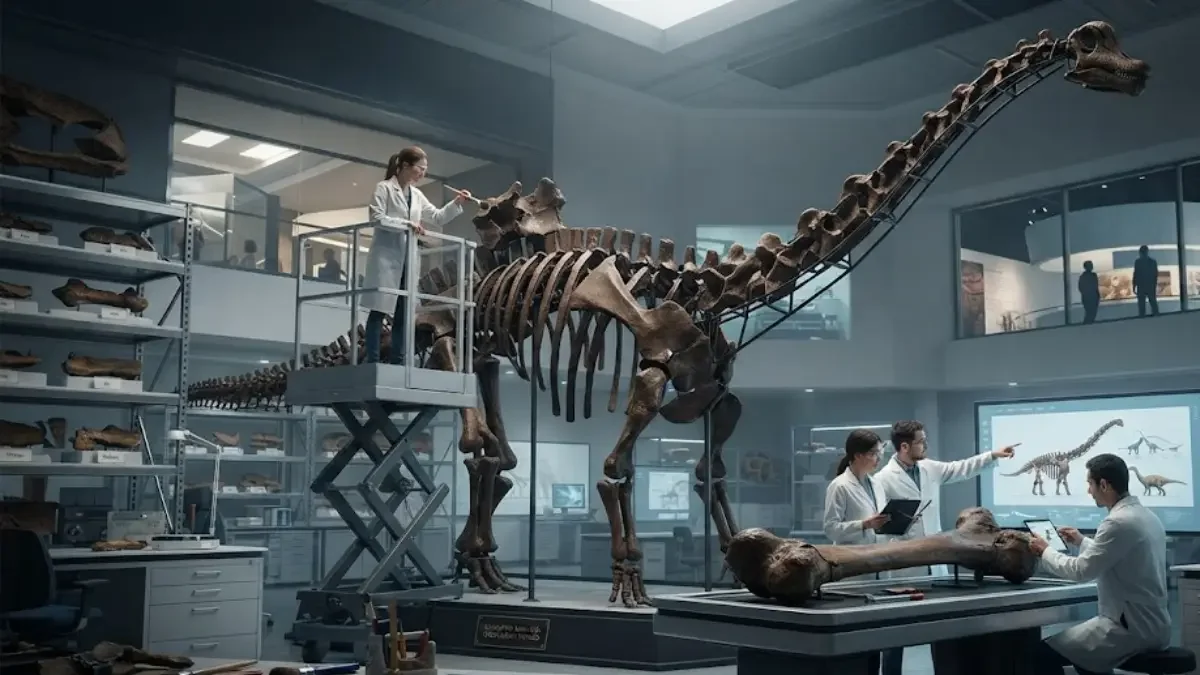
The pursuit of understanding Earth's largest historical lifeforms received fresh momentum following major fossil findings. Breakthrough excavations, such as the identification of massive new sauropod species like Dasosaurus tocantinensis unearthed in Brazil, demonstrate how ancient landmasses supported animals stretching nearly 20 meters long. Living around 120 million years ago during the Cretaceous period, these giant herbivores reveal complex evolutionary migration patterns across ancient supercontinents like Gondwana.
Simultaneously, marine fossil discoveries continue to unveil apex predators that dominated ancient seas. Long before modern whales evolved, prehistoric oceans teemed with colossal marine reptiles and giant sharks capable of dwarfing modern marine life. These discoveries highlight how aquatic environments provided the necessary buoyancy to support immense body masses without the strict gravity constraints faced by land animals.
Why These Discoveries Matter Today
Studying these colossal ancient creatures goes far beyond satisfying human curiosity about monsters. Understanding how prehistoric ecosystems supported such massive energy requirements gives scientists vital clues about biodiversity, climate resilience, and evolutionary adaptation. By examining how ancient species responded to environmental shifts, contemporary researchers gain better models for protecting modern ecosystems facing rapid ecological changes.
As paleontology embraces advanced technology—such as deep learning-aided bone segmentation and isotope-based fossil dating—our view of the ancient world becomes sharper. The real-life monsters of Earth's history may not breathe atomic fire, but their true stories are a testament to the staggering scale of evolution.
Frequently Asked Questions (FAQ)
Could a real animal ever grow as big as Godzilla?
No known land animal could reach Godzilla’s height of 50 to 100 meters due to the biological limits of the square-cube law, which dictates that weight increases exponentially faster than bone strength. However, marine animals like the blue whale have evolved to surpass fictional monsters in weight by utilizing oceanic buoyancy.
Are any dinosaurs directly related to Godzilla?
While Godzilla is fictional, its design was heavily inspired by large carnivorous theropod dinosaurs and armored reptiles. Paleontologists even named a real Triassic theropod dinosaur, Gojirasaurus, after the monster.
What was the largest creature to ever live on Earth?
The blue whale holds the title of the largest animal known to have ever lived, surpassing even the largest known dinosaurs in weight. Among land-dwelling dinosaurs, massive sauropods like Argentinosaurus and newly studied giants reached lengths of over 30 to 40 meters.
Why did prehistoric animals grow so much larger than modern land animals?
High concentrations of atmospheric oxygen, abundant food supplies, and different continental climates during epochs like the Mesozoic Era allowed certain lineages of plants and animals to evolve extreme gigantism.