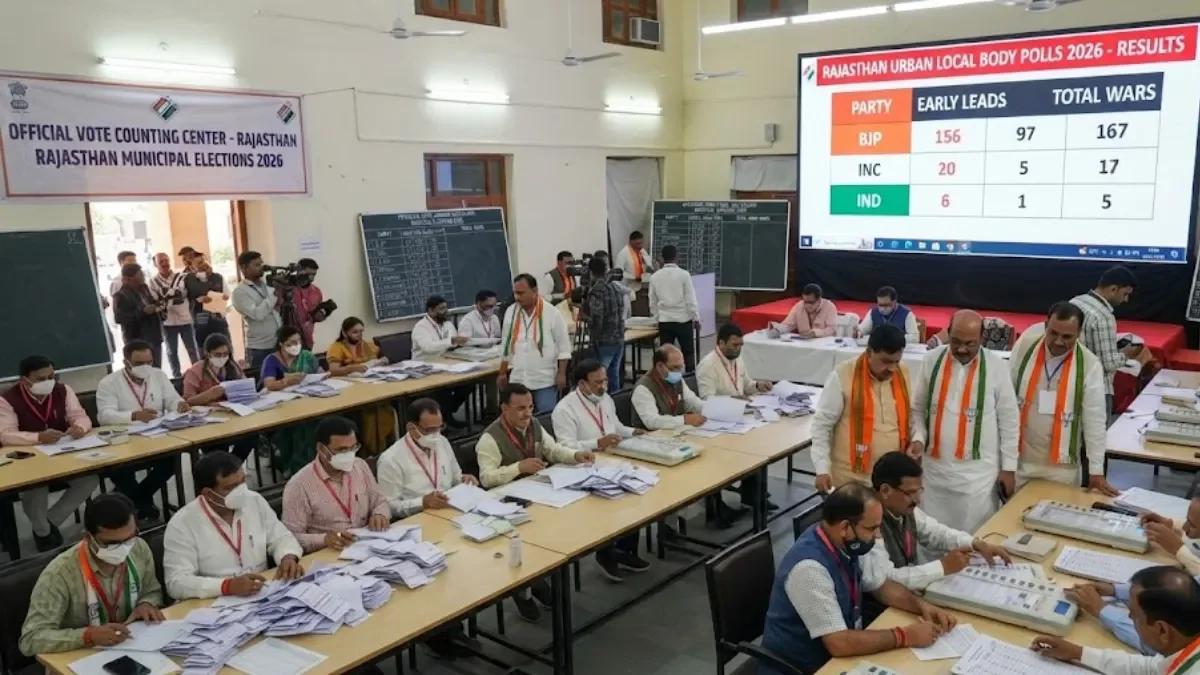
The political temperature in Rajasthan has risen sharply as counting of votes gets underway for 309 urban local bodies across the state. These crucial civic elections, conducted in two phases on September 9 and 11, cover thousands of wards and are widely viewed as a major grassroots indicator of public sentiment.
Early Trends and Electoral Edge
As initial numbers roll in from various municipal corporations, councils, and boards, the ruling Bharatiya Janata Party (BJP) has taken an early lead. Major urban centers such as Jaipur and Udaipur have shown strong initial momentum for the BJP, while the opposition Congress is putting up a firm fight in several key pockets and districts. Independent candidates are also emerging as significant players in multiple local bodies, capturing crucial blocks that could determine the final control of municipal boards.
Background and Significance of the Polls
Local body elections serve as the foundational bedrock of urban governance, dealing directly with civic infrastructure, sanitation, water supply, and local development projects. However, beyond local administration, these polls carry immense symbolic weight. For Chief Minister Bhajan Lal Sharma’s government, a strong performance validates the ruling party's administrative trajectory. Meanwhile, the Congress party views these elections as a vital opportunity to sustain grassroots momentum following previous electoral cycles.
Impact on Ordinary Citizens and Local Governance
For everyday residents across Rajasthan, the outcome of these municipal polls directly influences urban policy implementation, local tax structures, and developmental funding over the coming years. City dwellers look to municipal corporations to resolve localized civic challenges, making the choice of local councillors critical for daily neighborhood welfare.
What Lies Ahead
As the counting process continues through the day, final majorities in several municipal councils and corporations will dictate the election of mayors and chairpersons. Political analysts are closely tracking these trends to gauge shifting voter patterns ahead of future statewide political milestones, including the build-up toward the 2028 Assembly elections.