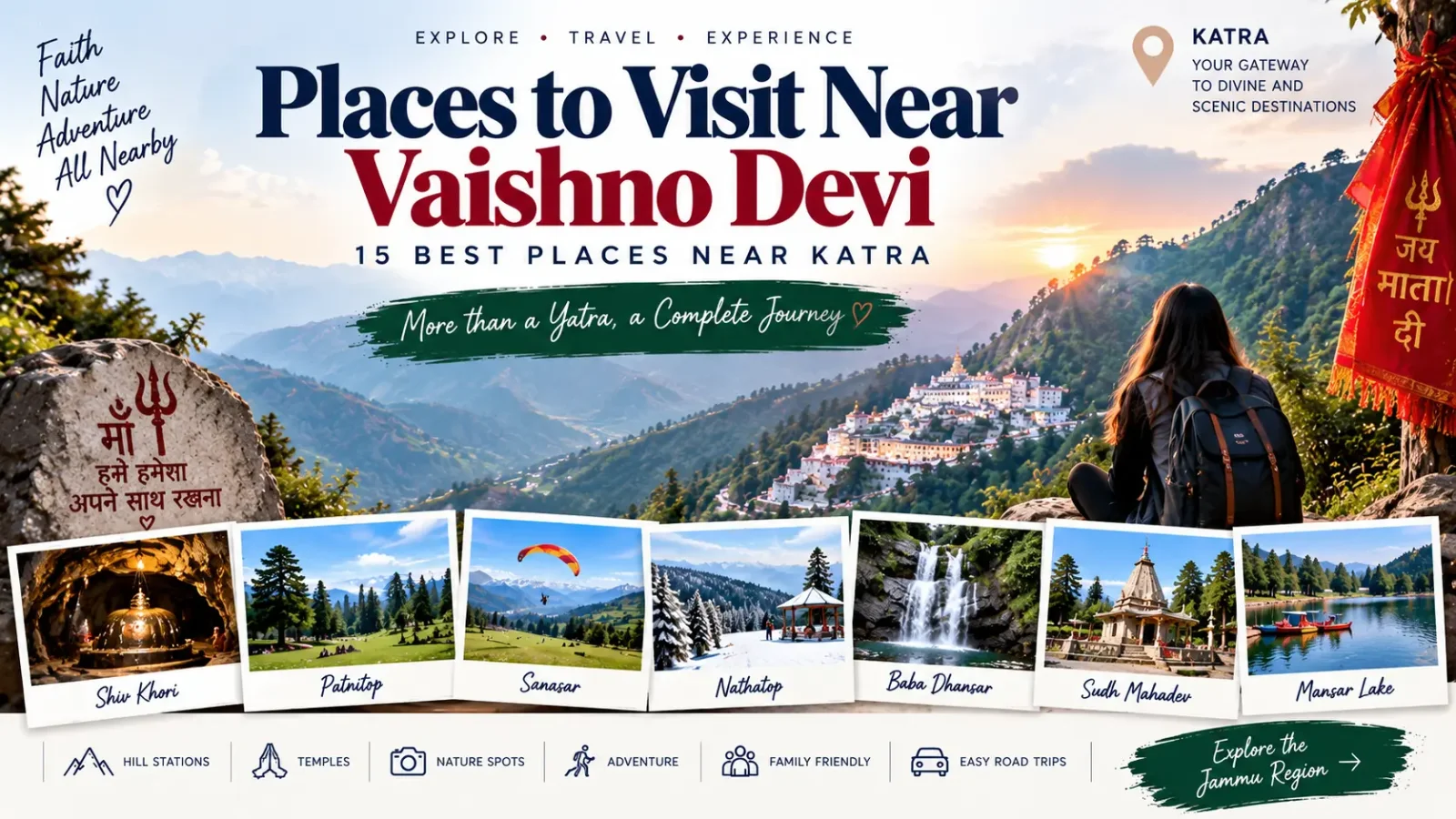
Planning a Vaishno Devi Yatra in 2026✨ Don't end your journey immediately after darshan. Katra and the surrounding Jammu region have several religious sites, waterfalls, hill stations, temples and scenic destinations that can turn your pilgrimage into a memorable 3–5 day trip.
Some of the best places to visit near Vaishno Devi include Bhairavnath Temple, Ardhkuwari, Banganga, Baba Dhansar, Shiv Khori, Patnitop, Nathatop, Sanasar and Jammu.
Whether you have only a few hours after your Yatra or another two or three days, this guide covers 15 of the best places to visit near Katra, including what each place is famous for and how to fit it into your itinerary.
Best Places to Visit Near Vaishno Devi at a Glance
| Place | Best For | Suggested Time |
|---|---|---|
| Bhairavnath Temple | Pilgrimage | During Vaishno Devi Yatra |
| Ardhkuwari | Pilgrimage & cave | During Yatra |
| Banganga | Religious stop | During Yatra |
| Charan Paduka | Religious significance | During Yatra |
| Baba Dhansar | Temple & waterfall | 2–3 hours |
| Shiv Khori | Shiva cave pilgrimage | Full-day trip |
| Nau Devi Cave Temple | Religious visit | 1–2 hours |
| Patnitop | Hill station & nature | 1–2 days |
| Nathatop | Mountain views & snow | Half day |
| Sanasar | Nature & adventure | Half/full day |
| Sudh Mahadev | Shiva pilgrimage | Half day |
| Mantalai | Spiritual & scenic | 1–2 hours |
| Jhajjar Kotli | Nature & picnic | 2–3 hours |
| Jammu | Temples & sightseeing | 1 day |
| Mansar Lake | Lake & nature | Half/full day |
1. Bhairavnath Temple
For pilgrims visiting Mata Vaishno Devi, Bhairavnath Temple is one of the most significant places to visit around the Holy Bhawan.
Located above Bhawan in the Trikuta Hills, the temple is dedicated to Bhairon Nath.
According to the traditional belief associated with the Vaishno Devi pilgrimage, devotees visit Bhairon Temple after Mata Rani's darshan.
The Shri Mata Vaishno Devi Shrine Board lists Bhairon Ghati at an altitude of approximately 6,619 feet, compared with Bhawan at approximately 5,200 feet.
The Shrine Board also operates the Bhawan–Bhairon passenger ropeway, subject to operating conditions.
Why visit?
Religious significance, mountain views and completion of the traditional Vaishno Devi pilgrimage.
Best for
Pilgrims already undertaking the Vaishno Devi Yatra.
2. Ardhkuwari Cave
Ardhkuwari, also written Adhkuwari, is one of the most important stops on the Vaishno Devi route.
It lies approximately 6 km from Katra on the traditional pilgrimage route.
The site is famous for the Garbh Joon cave and its association with Mata Vaishno Devi.
According to religious tradition, Mata Vaishnavi meditated here before continuing towards the Holy Cave.
Because it falls naturally on the pilgrimage route, you do not need a separate sightseeing day for Ardhkuwari if you're completing the traditional Vaishno Devi Yatra.
Why visit?
Sacred cave, religious significance and an important milestone during the trek.
Best for
Vaishno Devi pilgrims and spiritual travellers.
3. Banganga
Banganga is one of the first major religious stops after pilgrims begin their journey from Katra.
According to Vaishno Devi tradition, Mata Vaishnavi created the stream by shooting an arrow into the ground when water was needed during her journey.
Today, Banganga remains an important landmark on the traditional pilgrimage route.
Why visit?
Religious importance and its close association with the story of Mata Vaishno Devi.
Best for
Pilgrims beginning the traditional trek from Katra.
4. Charan Paduka
Continue along the traditional route and you reach Charan Paduka, approximately 2.5 km from Katra according to the Shrine Board's distance information.
The site is associated with the sacred footprints of Mata Vaishno Devi.
Although many pilgrims focus primarily on reaching Bhawan, stopping at important traditional points such as Banganga, Charan Paduka and Ardhkuwari gives a deeper understanding of the pilgrimage route.
Why visit?
Religious importance and views of the surrounding Trikuta Hills.
Best for
Pilgrims following the traditional Vaishno Devi route.
5. Baba Dhansar
If you're searching for a combination of nature and spirituality near Katra, Baba Dhansar deserves a place in your itinerary.
The destination is known for a sacred Shiva site surrounded by lush vegetation and flowing water.
Its natural setting makes the experience noticeably different from the busy streets and pilgrimage areas around Katra.
Visitors should expect some walking and steps to reach the site.
Why visit?
Temple, natural surroundings, flowing water and photography.
Best for
Families, religious travellers and nature lovers.
Suggested time
Around 2–3 hours, excluding travel time.
6. Shiv Khori
Shiv Khori is one of the most important religious excursions you can add after Vaishno Devi.
Situated near Ransoo in Reasi district, Shiv Khori is a natural cave shrine dedicated to Lord Shiva.
The cave is approximately 200 metres long, while pilgrims travel by road to Ransoo before completing an approximately 3 km walking route towards the shrine.
Inside is a naturally formed Shivling worshipped by devotees.
The cave's unusual natural formation and spiritual significance make Shiv Khori considerably more than a standard temple visit.
Why visit?
Natural cave shrine, Lord Shiva pilgrimage and mountain surroundings.
Best for
Pilgrims, families and travellers interested in religious tourism.
Suggested time
Keep a full day from Katra.
Internal link: Read our complete Shiv Khori Yatra 2026 guide for the trek, route, cave and travel information.
7. Nau Devi Cave Temple
Nau Devi, also known as the Nau Deviyan cave temple, is another religious attraction in the Katra region.
The temple is associated with nine forms of Goddess Durga and can be included in a short religious sightseeing itinerary around Katra.
It is especially suitable for travellers who want to explore additional spiritual destinations without planning another strenuous mountain trek.
Why visit?
Cave temple and religious atmosphere.
Best for
Families and devotees.
Suggested time
Around 1–2 hours depending on travel and crowd conditions.
8. Patnitop
After several days of pilgrimage, you may want somewhere to simply relax.
That's where Patnitop fits perfectly.
Located in the Jammu region, Patnitop is a popular hill destination known for forests, mountain scenery, open meadows, winter snow and adventure experiences.
Instead of returning directly home after Vaishno Devi, travellers can spend one or two nights here.
During warmer months, Patnitop offers green landscapes and pleasant mountain surroundings. Winter creates a completely different experience, with the possibility of snow depending on current weather.
Why visit?
Mountains, forests, snow, nature and a relaxed atmosphere.
Best for
Couples, families, friends and nature lovers.
Suggested stay
1–2 days.
Internal link: See our complete Patnitop Travel Guide 2026 for places to visit, snowfall, weather and a 2-day itinerary.
9. Nathatop
If you're visiting Patnitop, add Nathatop to the same itinerary.
Located at a higher elevation than the main Patnitop area, Nathatop is known for panoramic mountain scenery.
During winter, the landscape may receive snow, making it particularly popular among travellers visiting from the plains.
However, snowfall cannot be guaranteed on a specific date, and road accessibility can change during severe winter weather.
Why visit?
Mountain views, snow experiences and photography.
Best for
Couples, families, photographers and winter travellers.
Suggested time
Half day.
10. Sanasar
For travellers who want something more adventurous, continue towards Sanasar.
The destination is known for its large meadow-like landscape surrounded by mountains and forests.
Adventure activities such as paragliding are associated with the area, although their availability depends on weather, season and current operations.
Even without adventure activities, Sanasar is worth considering simply for its natural surroundings.
Why visit?
Meadows, mountains, photography and adventure.
Best for
Couples, friends, nature lovers and adventure travellers.
Suggested time
Half day to one full day.
11. Sudh Mahadev Temple
If your journey is primarily spiritual, consider adding Sudh Mahadev.
The temple is dedicated to Lord Shiva and is an important pilgrimage destination in the Jammu region.
It can work particularly well as part of a longer circuit involving:
Vaishno Devi → Shiv Khori → Patnitop → Sudh Mahadev
Travellers staying around Patnitop can combine Sudh Mahadev with Mantalai depending on road and weather conditions.
Why visit?
Lord Shiva temple, pilgrimage and spiritual significance.
Best for
Religious travellers and families.
12. Mantalai
Mantalai can be combined with Sudh Mahadev rather than treated as a separate full-day destination.
The location is associated with religious traditions involving Lord Shiva and Goddess Parvati.
Its mountain environment also makes it appealing to travellers interested in peaceful landscapes and spiritual tourism.
Why visit?
Religious significance, nature and peaceful surroundings.
Best for
Pilgrims and travellers visiting Sudh Mahadev.
13. Jhajjar Kotli
If waterfalls, greenery and picnic destinations interest you more than temples, consider Jhajjar Kotli.
Located along the Jammu region's road network, it is known for its natural surroundings and flowing water.
The destination can work as a stop while travelling between Jammu and other locations rather than requiring an entire vacation day.
Water levels and conditions naturally vary by season.
Why visit?
Nature, picnic atmosphere and short breaks.
Best for
Families, groups and road-trip travellers.
14. Jammu
Don't treat Jammu only as an airport or railway stop.
If you have an additional day, Jammu city has several attractions worth exploring.
One of the most important is Raghunath Temple, a major Hindu temple complex in the city.
You can also explore local markets, temples and other heritage attractions depending on your available time.
Jammu works particularly well as the first or final day of a Vaishno Devi itinerary.
Why visit?
Temples, local culture, food, markets and city sightseeing.
Best for
Families, pilgrims and first-time visitors to the Jammu region.
Suggested time
One full day.
15. Mansar Lake
For travellers with additional time, Mansar Lake offers another side of Jammu tourism.
Surrounded by hills and greenery, the lake is known both for its scenic environment and religious associations.
It is better suited to a longer Jammu itinerary than a very short Katra trip because of the additional road travel involved.
Why visit?
Lake views, nature, photography and a relaxed day trip.
Best for
Families, couples and nature lovers.
Which Places Should You Visit Near Vaishno Devi?
The right choice depends on how much time you have.
If You Have Only a Few Hours
Explore attractions naturally connected with your Vaishno Devi Yatra, including:
Banganga → Charan Paduka → Ardhkuwari → Bhawan → Bhairavnath
These are part of the pilgrimage itself rather than separate day trips.
If You Have 1 Extra Day
Choose Shiv Khori if pilgrimage is your priority.
Choose Baba Dhansar + nearby Katra sightseeing if you prefer a shorter and less demanding outing.
Choose Patnitop if you want mountains and relaxation.
If You Have 2 Extra Days
A good combination is:
Patnitop → Nathatop → Sanasar
This changes the character of your trip from purely religious tourism to a combination of pilgrimage, mountains and nature.
If You Have 3+ Extra Days
You can create a broader circuit:
Vaishno Devi → Shiv Khori → Patnitop → Nathatop → Sanasar
Add Jammu sightseeing if your return flight or train schedule allows.
Best Places Near Vaishno Devi for Couples
Couples looking for scenic surroundings rather than another pilgrimage should prioritize:
Patnitop, Nathatop and Sanasar.
Patnitop offers forests and mountain scenery, Nathatop provides panoramic viewpoints, while Sanasar offers peaceful landscapes and seasonal adventure experiences.
A two-night stay around Patnitop gives couples more time to explore without rushing back to Katra.
Best Places Near Vaishno Devi for Families
Families can consider:
Baba Dhansar, Shiv Khori, Patnitop, Jammu and Mansar Lake.
Your choice should depend on the age and mobility of family members.
If travelling with elderly family members or very young children, avoid building an itinerary that requires difficult walking on consecutive days immediately after the Vaishno Devi trek.
Best Religious Places Near Vaishno Devi
For a pilgrimage-focused journey, consider:
Bhairavnath Temple, Ardhkuwari, Banganga, Charan Paduka, Shiv Khori, Nau Devi and Sudh Mahadev.
This creates a much broader religious journey than visiting only the main Vaishno Devi shrine.
Best Hill Stations and Nature Spots Near Katra
For nature and mountains, prioritize:
Patnitop → Nathatop → Sanasar
Baba Dhansar and Jhajjar Kotli can be added if you prefer waterfalls and shorter nature stops.
3-Day Vaishno Devi Itinerary
Day 1 – Arrive in Katra
Reach Katra, check into your hotel and rest.
Complete the necessary preparations for the Vaishno Devi Yatra.
Avoid beginning a strenuous trek immediately after an exhausting overnight journey if possible.
Day 2 – Vaishno Devi Yatra
Start the pilgrimage according to your preferred schedule.
Depending on your chosen route, visit:
Banganga → Charan Paduka → Ardhkuwari → Bhawan → Bhairavnath
Return to Katra and rest.
Day 3 – Baba Dhansar / Local Sightseeing
Keep the final day relatively relaxed.
Visit Baba Dhansar or another nearby attraction before continuing your onward journey.
5-Day Vaishno Devi + Shiv Khori + Patnitop Itinerary
Want to turn the pilgrimage into a proper vacation? Try this itinerary.
Day 1 – Arrive in Katra
Check in and rest.
Day 2 – Vaishno Devi
Complete your Vaishno Devi Yatra and return to Katra.
Day 3 – Shiv Khori
Take a full-day trip from Katra towards Ransoo and Shiv Khori.
Return and rest.
Day 4 – Katra to Patnitop
Travel towards Patnitop.
Spend the rest of the day exploring the main Patnitop area and enjoying the mountain environment.
Day 5 – Nathatop + Sanasar
Explore Nathatop and Sanasar before continuing towards Jammu, Katra or your next destination.
For families or travellers who prefer a slower pace, add an extra rest day after the Vaishno Devi Yatra.
Best Time to Visit Places Near Vaishno Devi
The best time depends heavily on the type of trip you want.
March to June
Spring and early summer are suitable for sightseeing and mountain trips.
Patnitop, Nathatop and Sanasar become attractive for travellers looking to escape hotter temperatures in the plains.
July to September
The monsoon can bring rain to the region.
Mountain roads, walking paths and outdoor activities can be affected, so check current weather and road advisories before departure.
October to November
Post-monsoon months can provide cooler conditions and are useful for combining pilgrimage with sightseeing.
December to February
Winter is attractive for travellers hoping to experience snow around Patnitop and Nathatop.
However, snowfall cannot be guaranteed for any particular date, and severe weather can temporarily affect road access.
Travel Tips for Exploring Places Near Katra
Don't try to cover all 15 destinations in one trip.
Choose places based on the number of days available and the physical ability of everyone travelling with you.
After completing the Vaishno Devi trek, allow adequate recovery time before planning another strenuous walking day.
Keep warm layers even outside peak winter when visiting higher mountain destinations.
During monsoon and winter, check current road and weather conditions before leaving Katra.
For shrine-related bookings and official Vaishno Devi information, use the Shri Mata Vaishno Devi Shrine Board rather than relying solely on travel agents or unofficial websites.
Frequently Asked Questions
What are the best places to visit near Vaishno Devi?
Some of the best places near Vaishno Devi include Bhairavnath Temple, Ardhkuwari, Banganga, Baba Dhansar, Shiv Khori, Patnitop, Nathatop, Sanasar, Sudh Mahadev and Jammu.
What can I visit near Katra after Vaishno Devi?
For religious tourism, visit Shiv Khori or Baba Dhansar. For mountains and relaxation, travel towards Patnitop, Nathatop and Sanasar.
Which hill station is near Vaishno Devi?
Patnitop is one of the most popular hill destinations to combine with a Katra and Vaishno Devi trip.
Is Patnitop worth visiting after Vaishno Devi?
Yes. Patnitop offers a completely different experience from the pilgrimage, with forests, mountain scenery, seasonal snow and nearby attractions such as Nathatop and Sanasar.
Can we visit Shiv Khori and Vaishno Devi on the same trip?
Yes. Both can be included in the same itinerary, but keeping Shiv Khori on a separate day makes the journey more comfortable.
How many days are enough for Vaishno Devi and nearby places?
Keep around 3 days for a basic Vaishno Devi and Katra trip. For Vaishno Devi plus Shiv Khori and Patnitop, approximately 5–6 days provides a more comfortable itinerary.
What are the best places near Vaishno Devi for couples?
Patnitop, Nathatop and Sanasar are particularly suitable for couples interested in mountains, scenery and a relaxed getaway.
What are the best places near Vaishno Devi for families?
Families can consider Baba Dhansar, Shiv Khori, Patnitop, Jammu and Mansar Lake, depending on the age and mobility of family members.
Can I see snow near Vaishno Devi?
Travellers hoping to see snow commonly consider higher destinations such as Patnitop and Nathatop during winter. Snowfall varies each year and cannot be guaranteed for specific dates.
Is one day enough for Patnitop from Katra?
A day trip can cover some major attractions, but staying one night or two days gives you more time for Patnitop, Nathatop and Sanasar.
Final Thoughts
A trip to Vaishno Devi doesn't have to end when you return to Katra.
Within the wider Jammu and Reasi region, you can experience sacred caves, Shiva temples, waterfalls, hill stations, mountain meadows, adventure activities and peaceful lakes.
Pilgrims can continue their spiritual journey to Shiv Khori, Baba Dhansar and Sudh Mahadev, while nature lovers can head towards Patnitop, Nathatop and Sanasar.
If you have limited time, focus on one or two nearby destinations rather than trying to see everything.
For a more complete journey, spend around 5 days combining Vaishno Devi, Shiv Khori and Patnitop. This creates a balanced itinerary with pilgrimage, nature and mountain sightseeing.
Jai Mata Di — and have a safe journey!