Updated: September 14, 2026
Germany's stock market ended Monday in the red as weakness in technology, industrial and utility shares outweighed gains in several heavyweight companies, adding to a broader risk-off move across global markets.
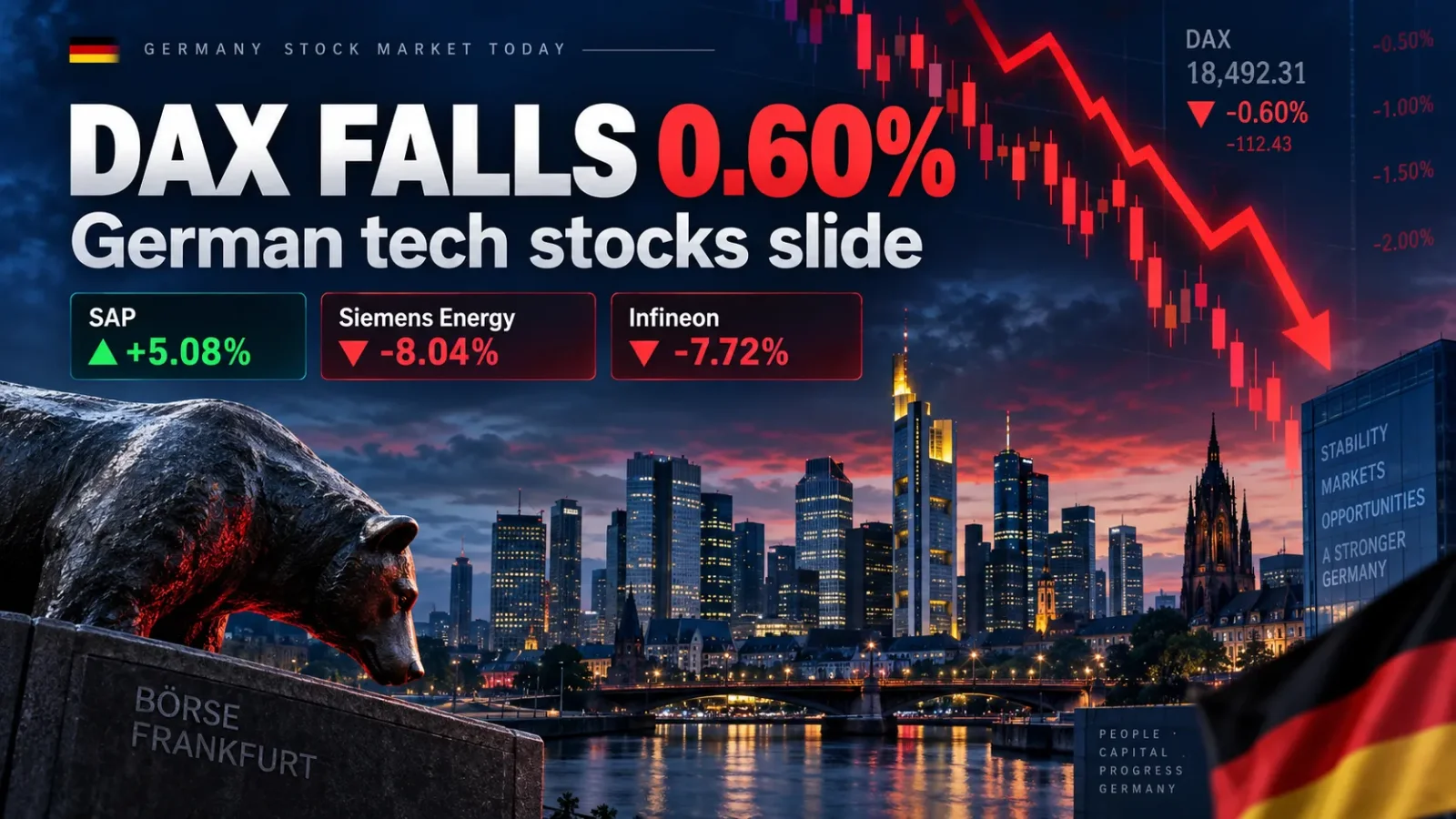
The benchmark DAX closed 0.60% lower, while Germany's mid-cap MDAX dropped 1.99% and the technology-heavy TecDAX declined 0.54%.
The session was particularly volatile beneath the headline index.
SAP surged more than 5%, making it the strongest performer in the DAX, while Siemens Energy dropped more than 8% and Infineon Technologies lost nearly 8%.
The selloff came as investors confronted several risks at once: growing concerns over the pace of artificial-intelligence development, sharply higher oil prices, rising government-bond yields and expectations that major central banks may need to remain restrictive for longer.
Quick Answer: Why Did Germany's DAX Fall Today?
The DAX fell 0.60% on September 14, 2026, primarily because losses in German technology, industrial and utility stocks outweighed gains in healthcare and software names.
Broader European technology stocks were also hit by fears that leading AI companies could slow the development of increasingly powerful artificial-intelligence systems.
At the same time, Brent crude traded above $100 a barrel, raising fresh inflation concerns and pushing bond yields higher.
The combination created a difficult environment for expensive technology and industrial stocks.
Germany Stock Market Today: Key Numbers
The major German indexes closed as follows:
DAX: -0.60%
MDAX: -1.99%
TecDAX: -0.54%
Market breadth was also negative.
On the Frankfurt Stock Exchange, 393 stocks declined compared with 282 advancing stocks, while 67 finished unchanged.
This is important because the weakness was not limited to only one or two large companies.
The decline spread across a significant part of the German market.
SAP Stock Surges More Than 5%
Despite the negative market backdrop, SAP was the standout DAX performer.
SAP shares climbed 5.08% to €186.26 at the close.
That move is especially noteworthy because global technology stocks were generally under pressure.
The divergence illustrates an important shift occurring within the global AI trade.
Investors appear to be differentiating between companies primarily dependent on massive AI infrastructure spending and software businesses that could use artificial intelligence to increase productivity or sell AI-enabled applications.
This trend was visible beyond Germany as well.
Reuters reported that several European software companies gained even as semiconductor and AI infrastructure shares declined.
That suggests the latest technology selloff may be less about investors abandoning artificial intelligence entirely and more about rotating between different parts of the AI ecosystem.
Why Did Infineon Stock Fall Nearly 8%?
German semiconductor company Infineon Technologies fell 7.72% to €54.04, making it one of the weakest DAX stocks of the session.
The decline came during a global semiconductor selloff.
Technology stocks around the world were hit after prominent AI industry leaders raised concerns about the pace at which frontier AI capabilities are advancing.
Anthropic CEO Dario Amodei has called for slowing the development of the most advanced AI systems so safety research can keep pace.
OpenAI CEO Sam Altman and Elon Musk also expressed support for greater caution around increasingly powerful AI systems.
That triggered fears that any slowdown in frontier-model development could eventually affect spending on chips, servers, networking hardware and data centres.
Semiconductor stocks are highly sensitive to this issue because the extraordinary AI investment boom has been a major source of demand across the chip industry.
Siemens Energy Falls More Than 8%
Siemens Energy dropped 8.04% to €132.66, making it the largest loser among major DAX constituents reported by Investing.com.
Industrial and infrastructure-related stocks were among the areas under pressure in Germany.
This occurred while investors were simultaneously dealing with higher financing costs.
When government-bond yields rise, borrowing becomes more expensive for companies and investors typically demand higher returns before purchasing riskier assets.
That can be particularly challenging for companies whose valuations depend on large future infrastructure projects.
MTU Aero Engines Also Declines
MTU Aero Engines fell 4.51% to €328.20.
The aviation-engine manufacturer joined the broader decline in German industrial names.
Higher oil prices can also become an indirect concern for the aviation industry because fuel represents one of the largest operating expenses for airlines.
Although higher crude prices do not automatically translate into weaker aircraft demand, sustained energy-price increases can reduce airline profitability and increase uncertainty around future fleet spending.
Bayer and Fresenius Medical Care Move Higher
Healthcare-related shares performed better than many cyclical sectors.
Fresenius Medical Care rose 2.91% to €39.56, while Bayer gained 2.41% to €49.33.
The relative strength fits a wider European pattern.
Reuters reported that healthcare stocks were among the strongest performers across Europe on Monday, with the sector gaining while technology shares declined.
Healthcare is often considered a more defensive area of the market because demand for medicines and medical services is generally less dependent on the economic cycle than industrial or technology spending.
During periods of market uncertainty, investors sometimes rotate toward such defensive companies.
MDAX Falls Almost 2%
Germany's MDAX performed significantly worse than the DAX, losing 1.99%.
This matters because the MDAX contains medium-sized German companies and can sometimes provide a clearer picture of domestic corporate sentiment than the multinational-heavy DAX.
The sharp decline suggests Monday's weakness extended beyond Germany's largest blue-chip companies.
Some individual MDAX stocks suffered particularly steep declines.
Aixtron fell 11.24%, while Hochtief dropped 9.37%.
AUTO1 Group also declined sharply during the session.
Aixtron Shares Collapse More Than 11%
Aixtron was among the biggest casualties of the technology selloff.
The German semiconductor-equipment company's shares fell 11.24% to €33.32.
That is significantly worse than the DAX itself and shows how aggressively investors sold companies associated with semiconductor capital expenditure.
Other TecDAX names were also under pressure.
SUSS MicroTec declined 9.45% and Siltronic fell 8.85%.
The pattern reinforces the conclusion that Monday's German market decline was heavily influenced by a global reassessment of technology and semiconductor valuations.
Why Are AI Slowdown Fears Affecting Germany?
Germany may not immediately come to mind when investors think about artificial intelligence.
But the country's stock market includes companies deeply integrated into the global semiconductor, automation, industrial-electronics and software supply chains.
Infineon produces semiconductors.
Aixtron supplies equipment used in chip manufacturing.
SAP is one of the world's largest enterprise-software companies.
Siemens and other German industrial groups are deeply involved in automation and digital infrastructure.
That means changes in global AI investment can have direct consequences for German corporate valuations.
Reuters reported that European technology stocks fell about 2.1% as markets reacted to the AI slowdown discussion.
Is the AI Boom Ending?
The latest selloff does not necessarily mean the AI boom is over.
There is an important difference between:
slower development of frontier AI models
and
slower adoption of artificial intelligence by businesses.
Even if developers become more cautious about training increasingly powerful models, companies may continue deploying existing AI technologies across customer service, software development, manufacturing, cybersecurity and data analysis.
That could explain why software stocks such as SAP performed comparatively well while semiconductor companies were punished.
The market may be moving from a simple “buy everything connected with AI” trade toward a much more selective one.
Oil Prices Add Another Problem for German Stocks
Technology was not the only problem facing Germany's market.
Oil prices also climbed sharply.
Investing.com reported crude oil futures around $102.49 per barrel, while Brent traded near $107.03 during the session.
Reuters reported that Brent briefly moved above $108 amid concerns about Middle Eastern supply disruptions.
Higher oil prices are particularly important for Germany because its industrial economy is heavily exposed to energy costs.
Manufacturers use substantial amounts of electricity and fuel.
Logistics companies face higher transportation costs.
Airlines pay more for fuel.
Consumers can face higher petrol and heating bills.
And higher energy prices can feed into inflation.
Why Higher Oil Can Hurt the DAX
Oil affects equities through several channels.
Higher crude prices can raise corporate operating costs.
Businesses may then either absorb those expenses, reducing profit margins, or pass them to customers through higher prices.
If higher energy costs increase inflation, the European Central Bank may also have less freedom to cut interest rates.
That creates another problem for stocks.
Higher rates generally reduce the present value investors place on future corporate earnings.
This is one reason high-growth technology stocks often struggle when bond yields rise.
German Bond Yields Are Also Rising
Bond markets were sending an equally important signal.
Reuters reported that German government-bond yields climbed to their highest levels since 2009 during Monday's global bond selloff.
A rising Bund yield effectively increases the risk-free return available to investors.
That can make equities less attractive.
For example, if government bonds provide substantially higher yields, investors may demand a greater potential return before accepting the additional uncertainty of owning stocks.
Companies with stretched valuations can therefore face particularly strong pressure.
Why Are European Markets Falling?
Germany's decline was part of a broader European move.
The pan-European STOXX 600 fell around 0.5%, with technology stocks among the biggest losers.
Markets were dealing simultaneously with:
AI investment uncertainty,
higher oil prices,
inflation concerns,
rising government-bond yields,
and expectations that global central banks could maintain tighter monetary policy.
This combination is particularly difficult for growth-oriented equities.
The DAX Decline Was Actually Smaller Than Some Tech Stocks Suggest
A 0.60% fall in the headline DAX might initially appear relatively modest.
But the index figure hides significant volatility underneath.
Infineon fell nearly 8%.
Siemens Energy lost more than 8%.
Aixtron dropped over 11%.
SUSS MicroTec fell more than 9%.
Siltronic declined almost 9%.
Meanwhile, SAP jumped more than 5%.
These large moves in opposite directions partly offset one another at index level.
That means Monday was less a uniform market collapse and more a major sector rotation.
Why SAP's Rally Matters
SAP's strong performance may offer one of the most interesting clues about how investors currently view AI.
Semiconductor companies benefited heavily from the first phase of the AI boom because developers needed unprecedented quantities of computing infrastructure.
The next phase could increasingly focus on software.
Businesses now want to know how to use AI to:
automate workflows,
analyse company data,
improve customer support,
reduce labour-intensive processes,
create software faster,
and increase employee productivity.
Enterprise-software companies could potentially benefit even if the pace of frontier AI model scaling moderates.
That does not guarantee SAP or other software shares will continue rising, but Monday's divergence shows investors are beginning to make this distinction.
What Should DAX Investors Watch Next?
The first factor is AI-sector sentiment.
If semiconductor shares stabilize, some of the pressure on Germany's technology sector could fade.
The second is oil prices.
A sustained move above $100 per barrel would increase inflation and industrial-cost concerns across Europe.
Third is German government-bond yields.
If yields continue climbing, equity valuations may remain under pressure.
Fourth is central-bank policy.
Markets are reassessing whether inflationary pressures could force major central banks to keep rates higher for longer.
Finally, investors should watch whether Monday's rotation from hardware toward software persists.
If SAP continues outperforming semiconductor companies, it could signal a broader change in how investors value the next stage of the AI boom.
What Does Germany's Market Decline Mean for Indian Investors?
Germany's stock market may appear distant from India, but the two markets are connected through global capital flows, technology spending and industrial trade.
A prolonged European slowdown can affect Indian exporters.
Higher global oil prices are also particularly relevant for India because India imports a large proportion of the crude oil it consumes.
Meanwhile, rising U.S. and European bond yields can influence foreign portfolio flows into emerging markets.
Indian investors therefore have reason to monitor German and European markets—especially when the same forces affecting Europe, such as oil prices and global technology sentiment, are also affecting Indian equities.
Germany Stock Market Today: Biggest DAX Winners
The leading DAX gainers reported at Monday's close were:
SAP: +5.08% to €186.26
Fresenius Medical Care: +2.91% to €39.56
Bayer: +2.41% to €49.33.
Germany Stock Market Today: Biggest DAX Losers
The biggest DAX decliners included:
Siemens Energy: -8.04% to €132.66
Infineon Technologies: -7.72% to €54.04
MTU Aero Engines: -4.51% to €328.20.
Bottom Line
Germany's DAX finished 0.60% lower on September 14, 2026, but the headline decline hides a much more dramatic shift underneath.
Technology, industrial and utility stocks came under pressure as investors reacted to global AI slowdown concerns, rising oil prices and higher bond yields.
Semiconductor-linked companies were particularly hard hit.
Infineon lost nearly 8%, while Aixtron fell more than 11%.
Siemens Energy also dropped more than 8%.
At the opposite end of the market, SAP surged 5.08%, demonstrating that investors are not abandoning technology entirely. Instead, money appears to be rotating between different parts of the sector.
The bigger question for Germany's stock market is therefore not simply whether AI growth will slow.
It is which companies still benefit if the AI investment cycle shifts from building infrastructure toward deploying software—and whether high oil prices and rising interest rates overwhelm that opportunity.
For DAX investors, those themes are likely to remain central in the sessions ahead.
Frequently Asked Questions
Why did the DAX fall today?
The DAX fell 0.60% as losses in technology, industrial and utility stocks outweighed gains in stocks such as SAP, Fresenius Medical Care and Bayer.
How much did the DAX fall on September 14, 2026?
Germany's DAX closed 0.60% lower. The MDAX lost 1.99%, while the TecDAX declined 0.54%.
Why did Infineon stock fall?
Infineon fell 7.72% during a wider global semiconductor selloff driven partly by concerns that slower frontier-AI development could affect future chip and data-centre spending.
Why did SAP stock rise?
SAP gained 5.08%. The move occurred during a broader rotation in which some software stocks outperformed semiconductor and AI-infrastructure companies.
Why did Siemens Energy stock fall?
Siemens Energy dropped 8.04%, making it one of the DAX's biggest losers during Monday's risk-off session.
What happened to the MDAX?
The MDAX fell 1.99%, considerably more than the DAX. Several mid-cap companies, including Aixtron and Hochtief, experienced particularly large declines.
How did European stocks perform?
The STOXX 600 fell approximately 0.5%, with technology shares among the weakest sectors as AI concerns, higher oil and inflation fears weighed on markets.
Are German stocks falling because of AI?
AI concerns are one contributor, particularly for semiconductor shares, but they are not the only reason. Higher oil prices, rising bond yields and inflation concerns are also influencing German and European equities.
Is the AI boom over?
There is not enough evidence to conclude that. Monday's trading showed a rotation from some semiconductor and infrastructure stocks toward software companies rather than a complete rejection of AI-related investments.
Is this investment advice?
No. This article is for informational purposes and does not constitute financial advice.
Source - Investing.com