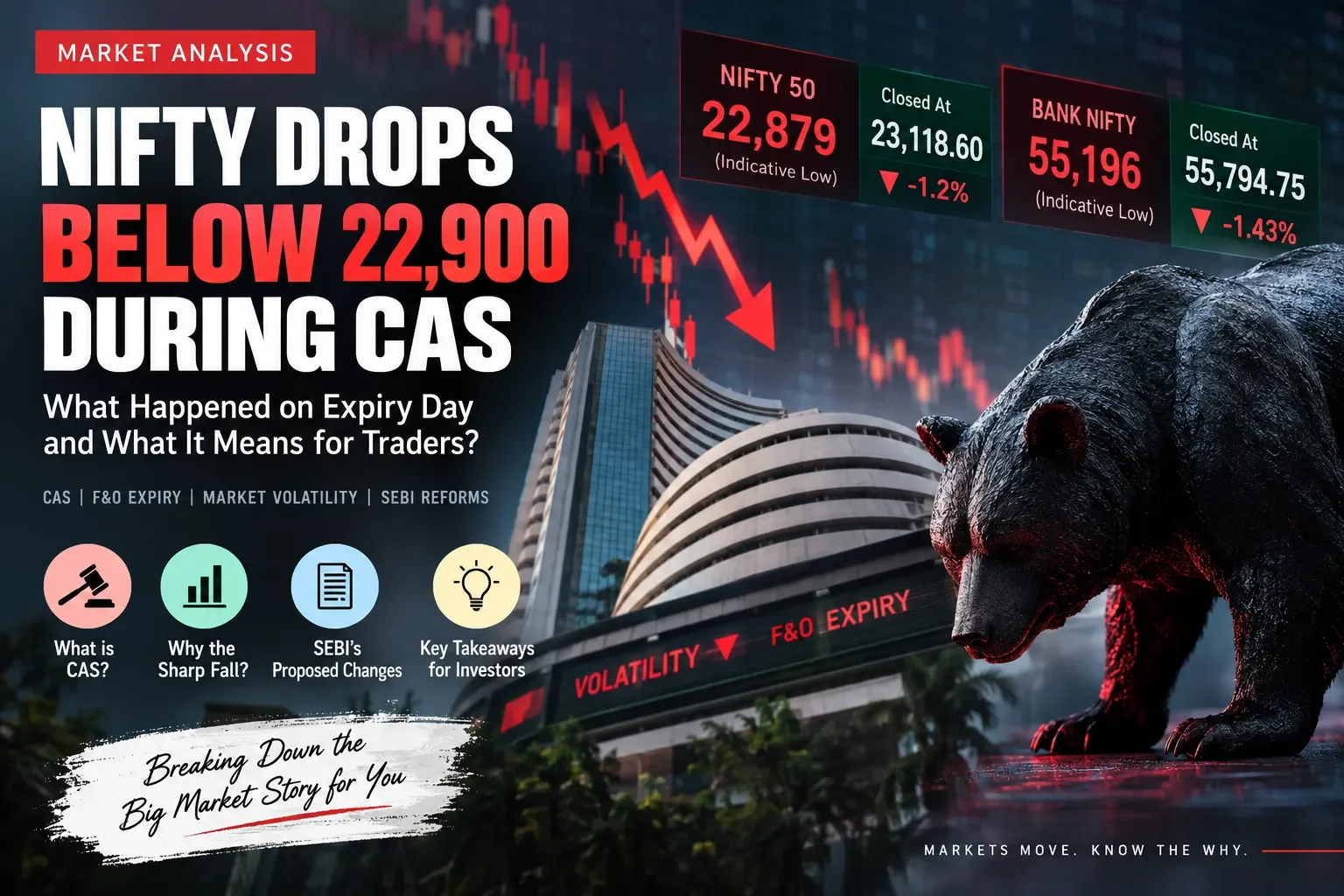
Nifty briefly slipped below 22,900 during the Closing Auction Session on September 15, 2026, while Bank Nifty dropped close to the 55,000 mark amid extreme expiry-day volatility. However, those were indicative auction levels—not the final closing values. Nifty eventually closed at 23,118.60, while Bank Nifty ended at 55,794.75.
Indian stock-market traders witnessed another unusually volatile expiry-day close on Tuesday, September 15, as the relatively new Closing Auction Session (CAS) triggered sharp movements in the indicative values of major indices.
At one stage during the indicative closing process, the Nifty 50 fell to around 22,879, representing a decline of about 2.2%, while Bank Nifty dropped to approximately 55,196, down roughly 2.5%. The moves were substantially larger than where the indices ultimately settled.
The episode has again raised an important question for investors and derivatives traders:
Why did Nifty suddenly fall below 22,900 near the market close?
Short answer: Nifty's brief fall below 22,900 was an indicative movement during the Closing Auction Session rather than its final closing price. Heavy expiry-day positioning, the CAS price-discovery mechanism and an already weak market environment combined to create unusually large fluctuations.
Nifty ultimately ended the session 1.2% lower at 23,118.60, while Bank Nifty closed 1.43% lower at 55,794.75. The Sensex finished at 74,003.82, down around 1%.
That difference is important.
From its indicative low of 22,879, Nifty recovered roughly 240 points before the official closing value was established.
Bank Nifty recovered almost 599 points from its indicative level near 55,196 to its eventual close of 55,794.75.
In other words, the dramatic numbers traders saw during CAS were not necessarily the levels at which the market ultimately closed.
Nifty, Bank Nifty and Sensex: What Happened on September 15?
Before CAS began, Indian equities were already under pressure.
At the end of continuous trading for CAS-eligible securities at 3:15 pm, Nifty stood around 23,172.35, down approximately 1%.
Sensex was around 74,171.82, down roughly 0.8%.
During the auction process, however, indicative index values fluctuated sharply.
The key levels were:
Nifty indicative low: 22,879
Nifty official close: 23,118.60
Nifty change: about -1.2%
Bank Nifty indicative level: around 55,196
Bank Nifty official close: 55,794.75
Bank Nifty change: about -1.43%
Sensex official close: 74,003.82
The episode was therefore partly a story about falling markets—but also about how closing prices are now determined for many major Indian stocks.
What Is the Closing Auction Session or CAS?
Closing Auction Session (CAS) is a special end-of-day auction used to determine the official closing prices of eligible stocks instead of relying only on their final continuous-market trades.
CAS was introduced for stocks in the cash market that have derivative contracts and was rolled out from August 3, 2026.
According to the NSE, CAS runs between 3:15 pm and 3:35 pm for applicable stocks.
The process broadly works as follows:
3:15–3:20 pm: Reference-price calculation and transition from continuous trading.
3:20–3:25 pm: Market and limit orders can be entered, modified or cancelled.
3:25–3:30 pm: Only limit orders can be entered or modified, with a system-driven random closure during the final two minutes.
3:30–3:35 pm: Orders are matched and trades confirmed.
The reference price for a stock is based on the volume-weighted average price of trades between 3:00 pm and 3:15 pm, while the permitted CAS price band is generally ±3% around the reference price.
This auction is designed to concentrate liquidity around the closing price and improve closing-price discovery.
But expiry days have revealed another side of the mechanism.
Why Is CAS Creating Such Large Expiry-Day Swings?
Expiry day is fundamentally different from a regular trading session.
Futures and options contracts approaching settlement create significant trading activity around the final reference or settlement price. Even relatively small changes in the underlying index can therefore have a significant effect on option premiums and derivative positions.
CAS adds another stage of price discovery near the close.
During the auction, orders are being collected and matched, so the indicative equilibrium price can move considerably before the auction is finalized.
That can temporarily cause the calculated indicative value of an index such as Nifty to move hundreds of points—even when the eventual closing level is far less extreme.
This is why traders should differentiate between:
Indicative CAS value → temporary price-discovery signal
and
Official closing value → finalized market close
The distinction has become particularly important for traders watching live index feeds on expiry days.
CAS Was Not the Only Reason Nifty Fell Today
It would also be incorrect to attribute the entire September 15 market fall to CAS.
Indian equities were already facing significant macroeconomic pressure.
Reuters reported that Nifty closed at a roughly five-month low, with investor sentiment affected by elevated crude-oil prices and rising global bond yields. Brent crude had climbed to around $107.8 per barrel, while the US 10-year Treasury yield was around levels not seen for nearly two decades.
Higher crude prices are particularly significant for India because the country imports a large proportion of its energy requirements.
Persistently expensive crude can increase concerns around inflation, the trade balance, the rupee and corporate costs.
Higher US bond yields can simultaneously make dollar-denominated fixed-income assets more attractive, creating another potential challenge for capital flows into emerging markets.
Financial and automobile stocks were among the weaker sectors during the session, while IT stocks provided some support.
So there were effectively two stories happening simultaneously:
A genuine market sell-off driven by macroeconomic pressures, and an unusually volatile price-discovery process near the close because of CAS and derivatives expiry.
Why September 15 Was Important for F&O Traders
The biggest issue for derivatives traders isn't simply whether Nifty closes higher or lower.
It is predictability of the settlement price.
When an index moves several hundred points during the closing auction, traders holding options close to expiry can experience rapid changes in the perceived value of their positions.
The September 15 episode was also not isolated.
Similar expiry-day volatility has been reported since CAS was introduced in August, increasing scrutiny of how closing auction prices interact with derivatives settlement.
That scrutiny has now reached SEBI.
SEBI Is Reviewing CAS and Expiry-Day Settlement Rules
On September 12, 2026, SEBI published a consultation paper titled “Review of certain aspects of the Closing Auction Session, Market Timings and Settlement Methodologies for Derivative Contracts.”
One of the most important issues under review is how the expiry settlement price of derivatives should be calculated.
According to reports on the consultation proposal, SEBI is examining two broad alternatives.
Option 1: Blended settlement calculation
The expiry settlement price could incorporate actual trading activity from the last 30 minutes of continuous trading along with trades executed through the closing auction.
The objective would be to reduce dependence on a single auction-derived closing point.
Option 2: Temporarily return to the earlier methodology
The derivatives settlement price could be based only on the final 30 minutes of regular continuous trading, effectively keeping CAS outside derivatives settlement calculations for at least a transitional period.
SEBI is therefore not necessarily considering abandoning CAS.
Instead, the regulatory debate centres on whether cash-market closing-price discovery and derivatives expiry settlement should depend on exactly the same mechanism.
Other Changes SEBI Is Considering
The consultation also considers measures aimed at making CAS more stable and predictable.
These reportedly include restricting certain order cancellations significantly away from the reference price, shortening the derivatives trading window following CAS and discontinuing publication of the estimated index-closing level during the auction.
That last proposal is particularly interesting after episodes such as September 15.
If market participants see Nifty flash at 22,879 during the auction, many naturally interpret the number as a major market crash.
But if the value is simply an evolving indicative calculation based on unmatched or changing auction orders, it may not represent where the index eventually settles.
Removing the indicative index figure could therefore reduce confusion—but it would also reduce the amount of real-time information visible to traders.
Did Nifty Actually Crash Below 22,900?
Nifty's indicative value did fall to approximately 22,879 during the closing auction, but Nifty did not finish the trading day below 22,900.
Its official September 15 close was 23,118.60.
This distinction matters both for investors and for anyone reading market headlines.
Saying simply that “Nifty closed below 22,900” would be incorrect.
A more accurate description is:
Nifty briefly indicated below 22,900 during CAS before recovering to close at 23,118.60.
That wording accurately describes both the severity of the auction volatility and the final market outcome.
What Does This Mean for Retail Investors?
For long-term investors, a temporary indicative swing during an auction usually matters far less than underlying earnings, valuations and economic trends.
For short-term traders—particularly those trading index options on expiry day—the situation is very different.
Settlement methodology directly influences how expiring contracts are valued.
That means traders increasingly need to understand not only technical levels such as support, resistance and open interest, but also the market microstructure that determines the official closing and settlement prices.
The September 15 session demonstrated why.
An investor looking only at the temporary Nifty reading near 22,879 would have seen a dramatically different picture from someone looking at the finalized close of 23,118.60.
Why CAS Exists in the First Place
Closing auctions themselves are not inherently unusual.
The objective is to create a transparent mechanism where buyers and sellers concentrate liquidity at the end of the trading session and arrive at a representative closing price.
When CAS was introduced in India, the intention was to improve the robustness of closing-price discovery and better align Indian markets with auction mechanisms used internationally.
The present controversy therefore isn't simply about whether an auction is good or bad.
The more specific question is:
How should a cash-market closing auction interact with a huge derivatives ecosystem whose contracts expire based on underlying market prices?
SEBI's current review appears designed to address precisely that issue.
What Happens Next?
Market participants will now closely watch the outcome of SEBI's consultation.
The regulator has sought feedback on its proposed changes, with the consultation process running into early October. Reports indicate that changes could potentially follow later in October or November, although the final framework will depend on SEBI's decision after stakeholder feedback.
Until then, CAS-related movements could remain an important feature of expiry-day trading.
For retail traders, one lesson is already clear:
An indicative CAS value should not automatically be treated as the market's final closing price.
The Bigger Picture
The September 15 market session brought together three powerful forces: a weak global macro backdrop, an F&O expiry and India's newly implemented closing-auction framework.
Nifty's temporary move below 22,900 grabbed attention, but the index ultimately closed more than 200 points above that auction low.
The episode therefore illustrates how the final minutes of trading have become increasingly important to understand.
Nifty's official 23,118.60 close still represented a significant decline and a weak session for Indian equities. But the much sharper intraday CAS reading reflected something different: the mechanics of closing-price discovery interacting with an enormous derivatives market.
Whether SEBI's proposed changes can reduce these expiry-day distortions without weakening the benefits of closing auctions will now be one of the most important market-structure developments to watch.
Frequently Asked Questions
Why did Nifty fall below 22,900 on September 15, 2026?
Nifty's indicative value fell to around 22,879 during the Closing Auction Session amid expiry-day volatility. It subsequently recovered and officially closed at 23,118.60.
What was Nifty's closing price on September 15, 2026?
Nifty 50 closed at 23,118.60, down approximately 1.2%.
What was Bank Nifty's closing price?
Bank Nifty ended the session at approximately 55,794.75, down around 1.43%.
Did Nifty close below 22,900?
No. Nifty briefly indicated around 22,879 during CAS, but its official closing value was 23,118.60.
What is CAS in the Indian stock market?
CAS stands for Closing Auction Session. It is an end-of-day auction used to determine closing prices for eligible stocks through concentrated buy and sell orders.
When was CAS introduced in India?
The new Closing Auction Session framework was rolled out from August 3, 2026 for eligible stocks with derivatives contracts.
Why is CAS causing volatility on F&O expiry days?
Derivative contracts are sensitive to their expiry settlement prices. Changing indicative prices during the closing auction can therefore produce unusually sharp movements in indices and option valuations near expiry.
Is SEBI changing the CAS rules?
SEBI issued a consultation paper on September 12 reviewing CAS, market timings and derivatives settlement methodology. Several possible changes are under consideration, but proposals should not be treated as final rules until SEBI formally implements them.
What is the difference between an indicative close and the official close?
An indicative close is an evolving estimate during the auction based on available orders. The official close is the finalized closing value after the auction and price-discovery process is completed.
What should investors watch now?
Investors and traders should monitor SEBI's final decision on derivatives settlement methodology, future expiry-day volatility, crude-oil prices, global bond yields and broader foreign-investor flows.
Disclaimer: This article is for informational and educational purposes only and should not be considered investment or trading advice. Market investments are subject to risk.
Source - MoneyControl