Updated: September 14, 2026
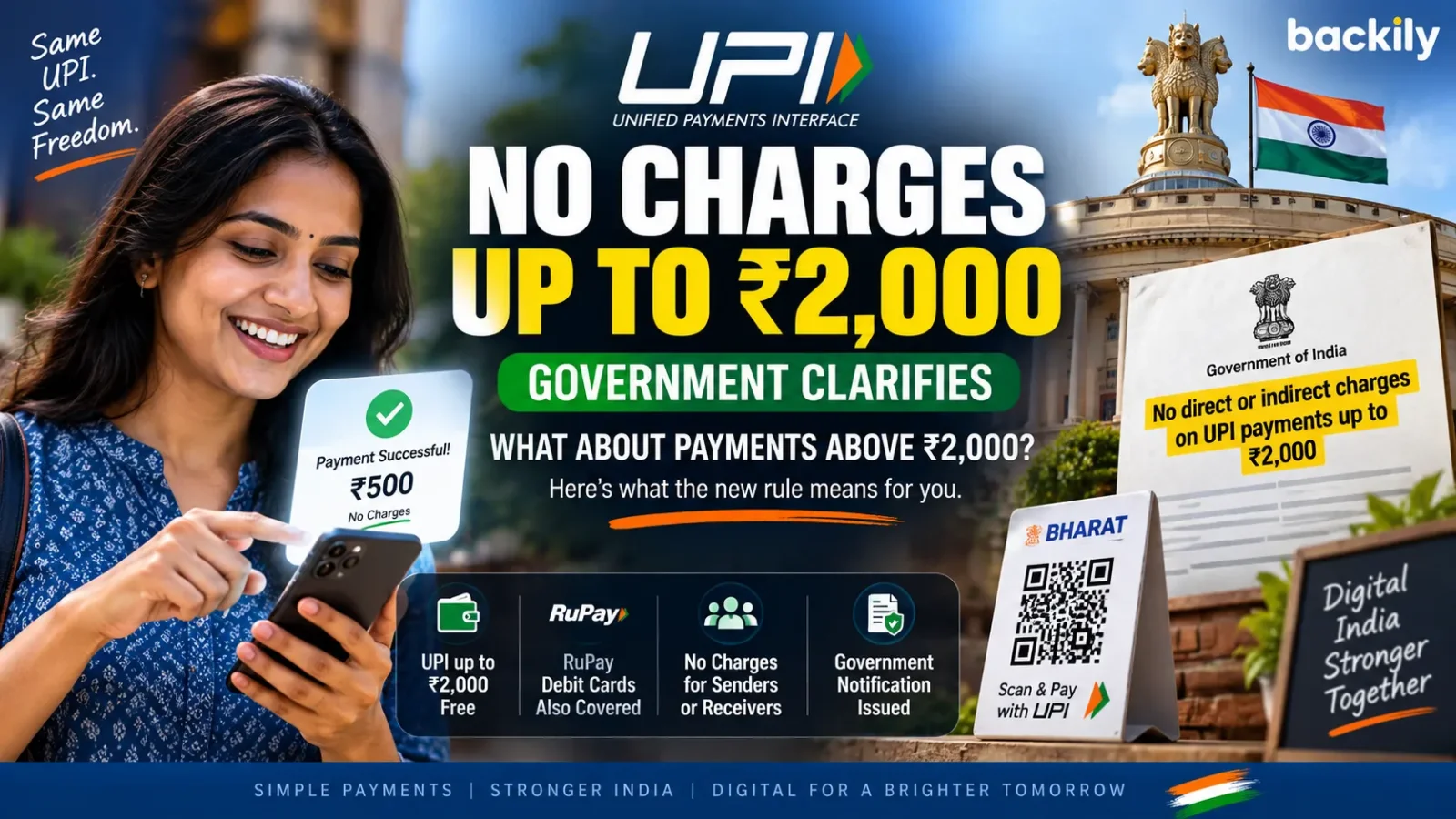
Millions of Indians who use UPI every day have received an important clarification from the government: banks and payment-system providers cannot impose direct or indirect charges on UPI payments of up to ₹2,000.
The protection also covers payments made using RuPay-powered debit cards.
The Finance Ministry's latest notification under the Payment and Settlement Systems Act, 2007 formally identifies UPI transactions up to ₹2,000 and RuPay debit-card payments as electronic modes protected from such charges.
The announcement comes after weeks of confusion over whether recent amendments to India's payments law could pave the way for charges on UPI.
However, an important question remains:
Does this mean UPI payments above ₹2,000 will now be charged?
The answer is no — not automatically.
The September 14 notification protects transactions up to ₹2,000, but it does not itself introduce a fee on every UPI transaction above that amount.
Here's what UPI users, merchants and businesses need to understand.
Quick Answer: Are UPI Transactions Up to ₹2,000 Free?
Yes. UPI payments of up to ₹2,000 are protected from direct or indirect transaction charges under the latest government notification.
Banks and payment-system providers cannot charge either the person making the payment or the person receiving it for transactions covered by the notification.
RuPay debit-card payments have also been included in the protected electronic payment modes.
For ordinary consumers, this means making a ₹100 payment at a tea shop, ₹500 payment at a restaurant or ₹1,999 payment to a merchant through regular UPI will not attract a bank or payment-system transaction charge under this framework.
What Has the Government Actually Changed?
The latest decision follows amendments to Section 10A of the Payment and Settlement Systems Act, 2007.
Earlier, certain prescribed electronic payment methods enjoyed statutory protection from charges.
Changes made in 2026 gave the central government greater flexibility to specify through notification which electronic payment methods and categories would continue to receive protection.
That change triggered speculation that the zero-MDR regime for UPI might disappear.
On August 8, however, the Finance Ministry publicly clarified that UPI would remain free for citizens and that person-to-person transactions would continue without transaction charges. The ministry also said that if MDR is introduced in future, it would apply only to a limited category of merchant transactions above a specified threshold.
The September 14 notification now provides more specific legal protection for UPI transactions up to ₹2,000.
Will UPI Payments Above ₹2,000 Be Charged?
This is likely to become the biggest search query following the announcement.
The answer is:
A UPI transaction above ₹2,000 does not automatically attract a charge simply because it exceeds ₹2,000.
The latest notification specifically protects transactions up to ₹2,000, but the government has not announced a blanket consumer fee on payments above ₹2,000.
The Finance Ministry has previously stated that consumers will continue to make UPI payments without transaction charges. It has also said any future MDR would be limited to certain merchant transactions rather than imposed universally.
Therefore, if you make a ₹5,000 or ₹10,000 UPI payment today, the latest notification should not be interpreted as an announcement that you must now pay a fee.
A separate policy or notification would be needed before any new MDR arrangement could be applied to eligible merchant transactions.
UPI Up to ₹2,000 vs Above ₹2,000: What Changes?
The most important distinction is between a protected transaction threshold and an actual fee being introduced.
For payments up to ₹2,000, the government has explicitly said banks and payment-system providers cannot levy direct or indirect charges under the notified framework.
Above ₹2,000, the government has created greater policy flexibility.
But policy flexibility is not the same as a transaction fee.
The Centre would still have to decide which merchant categories are covered, what transaction threshold applies, what MDR rate is permitted and when any such system begins.
None of those factors should be assumed merely because a payment exceeds ₹2,000.
Does the Rule Apply to Both Sender and Receiver?
Yes, according to the notification as reported by Reuters.
The rules say banks and payment-system providers cannot impose direct or indirect charges on a person making or receiving payments through the specified modes.
That wording is significant.
It protects not only the individual scanning a QR code but also the person or merchant receiving a qualifying payment from being charged under the protected category.
This is particularly relevant for India's small merchants, street vendors, taxi drivers, kirana stores and other businesses that depend heavily on QR-based UPI collections.
What Does “No Direct or Indirect Charge” Mean?
A direct charge would be easy to identify.
For example, a bank adding a ₹2 “UPI transaction fee” to a qualifying payment would be a direct charge.
An indirect charge could involve attempting to collect effectively the same transaction cost through another mechanism or label linked to the payment.
By prohibiting both direct and indirect charges, the legal wording is intended to prevent the protection from being bypassed simply by describing the cost differently.
However, normal charges unrelated to the UPI transaction itself — such as certain account services or unrelated commercial fees — should not automatically be confused with a prohibited UPI transaction charge.
What Is MDR and Why Is Everyone Talking About It?
MDR stands for Merchant Discount Rate.
It is generally a payment-processing fee borne by a merchant when accepting certain forms of digital payment.
With credit and some debit-card transactions, a portion of the transaction value can be distributed among entities involved in processing the payment.
Regular UPI merchant payments have largely operated under a zero-MDR framework since January 2020.
The government confirmed in 2025 that no MDR was being charged on UPI person-to-merchant transactions and therefore there was no GST applicable to an MDR that did not exist.
The debate resurfaced in 2026 because maintaining UPI infrastructure costs banks, fintech companies and payment providers money even when no transaction fee is collected.
Why Is the Government Considering MDR at All?
UPI has grown from a payments experiment into infrastructure used by hundreds of millions of Indians.
That scale creates substantial costs.
Payment companies need servers, cybersecurity infrastructure, fraud-monitoring systems, customer support, banking integrations and continuously available transaction-processing networks.
A parliamentary finance panel has previously highlighted the gap between government incentives and the industry's estimated cost of running the ecosystem.
This is why policymakers are considering how to make UPI financially sustainable over the long term without destroying one of its biggest advantages: cheap and accessible payments.
The government's August position was that if MDR eventually returns, it would be nominal and limited to a small group of merchant transactions, rather than becoming a universal consumer charge.
Are Person-to-Person UPI Transfers Still Free?
Yes.
The Finance Ministry explicitly said in August that all person-to-person, or P2P, UPI transactions will continue to be free of charge.
P2P transactions include situations such as sending money to a friend, transferring money to a family member or paying someone directly through their personal UPI ID.
That is different from a P2M, or person-to-merchant, transaction in which a customer pays a business.
The current policy discussion around potential future MDR has primarily centred on merchant payments.
What About Small Merchants?
Small merchants have been central to India's UPI strategy.
In an earlier government incentive programme, qualifying UPI payments of up to ₹2,000 to small merchants attracted zero MDR, while banks and payment-industry participants could receive a government-funded incentive.
The scheme provided a 0.15% incentive on eligible low-value transactions rather than making either the customer or small merchant pay for processing.
That model helped encourage businesses ranging from local grocery stores to street vendors to accept digital payments.
The government has repeatedly indicated that financial inclusion and small-merchant adoption remain important considerations in any future changes to the UPI charging framework.
Are RuPay Debit Card Payments Also Free?
The September 14 notification also covers RuPay-powered debit-card payments.
Reuters reported that the notification designates RuPay debit cards alongside qualifying UPI payments and prevents banks or system providers from imposing direct or indirect charges on people making or receiving protected payments.
This is important because RuPay forms another major part of India's domestic digital-payments ecosystem.
Does This Apply to RuPay Credit Cards on UPI?
Consumers should distinguish between a RuPay debit card and a RuPay credit card linked to UPI.
The latest notification specifically refers to RuPay-powered debit cards alongside UPI transactions up to ₹2,000.
Credit-card-on-UPI transactions operate under a different commercial structure and should not automatically be assumed to have exactly the same MDR treatment as regular bank-account UPI transactions.
That distinction is especially important when reading social-media messages claiming that “all UPI is free under all circumstances.”
Why ₹2,000?
The ₹2,000 figure is not entirely new to India's digital-payment policy.
The government has previously used ₹2,000 as the boundary for its incentive scheme supporting low-value UPI merchant transactions.
Under the earlier scheme, transactions of up to ₹2,000 involving small merchants qualified for a government incentive while continuing to have zero MDR.
The threshold reflects the importance of low-value everyday payments — the kind of transactions UPI has largely replaced cash for across India.
UPI Has Become Critical Infrastructure for India
The significance of any UPI policy change becomes clearer when looking at its scale.
The Finance Ministry said UPI processed 2,366 crore transactions worth ₹29.9 lakh crore in July 2026 alone. It also said UPI was operational in 11 countries as India's payment system continued expanding internationally.
Separate government data released around UPI's 10th anniversary showed that annual transaction volume had risen from just 1.78 crore transactions in FY 2016-17 to more than 24,162 crore in FY 2025-26.
This scale explains why even a small change in UPI pricing policy has consequences for banks, fintech companies, merchants and consumers.
Could Google Pay, PhonePe or Paytm Start Charging Users?
The latest development should not be interpreted as permission for major UPI apps to start charging users for qualifying transactions up to ₹2,000.
The government's notification prevents banks and payment-system providers from imposing direct or indirect charges on transactions covered by the protection.
UPI apps may separately offer other paid financial or commercial services, but that is different from imposing a transaction charge on an ordinary protected UPI payment.
Consumers should therefore distinguish between a fee for an optional service and a fee for simply sending or receiving a qualifying UPI payment.
What Does This Mean for Businesses?
For small merchants, the immediate situation remains largely reassuring.
Low-value digital payments — which make up a significant portion of everyday QR-code transactions — remain specifically protected.
Larger businesses, however, should continue monitoring future government notifications.
The 2026 amendment gives policymakers greater flexibility to introduce a calibrated MDR on specific categories of merchant payments in future.
The government has indicated that any such MDR would be significantly lower than conventional debit- or credit-card MDR and would apply only to limited merchant transactions above a threshold.
But an enabling provision should not be mistaken for an already-imposed fee.
Will GST Be Charged on UPI Transactions Above ₹2,000?
Another recurring claim is that UPI transactions over ₹2,000 attract GST.
That claim has previously been rejected by the government.
In April 2025, the Finance Ministry called reports that the government planned to levy GST on UPI transactions above ₹2,000 false and misleading.
The ministry explained that GST could apply to a payment-processing charge such as MDR — not to the underlying money being transferred simply because the payment exceeded ₹2,000.
Therefore, sending ₹3,000 through UPI does not by itself mean that GST is charged on ₹3,000.
Does This Mean UPI Will Always Be Completely Free?
For ordinary consumers, the government has repeatedly said that UPI will remain free for citizens.
For merchants, the long-term picture is more nuanced.
The government wants to protect digital-payment adoption while also ensuring the UPI ecosystem remains financially sustainable.
That creates the possibility that a limited MDR framework could eventually emerge for some larger or higher-value merchant transactions.
If that happens, it would require further policy details.
For now, the important distinction is simple:
The government has protected UPI payments up to ₹2,000 from direct and indirect charges. It has not announced a blanket fee on every UPI payment above ₹2,000.
Bottom Line
The government's September 14, 2026 notification provides an important clarification for India's digital-payment users.
UPI transactions up to ₹2,000 cannot attract direct or indirect charges from banks or payment-system providers, and RuPay debit-card payments are also covered by the notified protection.
But consumers should not misunderstand the ₹2,000 threshold.
A ₹2,001, ₹5,000 or ₹10,000 UPI payment does not automatically become chargeable simply because it exceeds ₹2,000.
The government's broader position remains that consumers will not be charged for UPI and P2P transfers will remain free. Any future MDR is expected to concern only a limited category of merchant transactions and would require further policy details.
For millions of people using UPI for everyday payments, the immediate takeaway is therefore straightforward:
Your routine low-value UPI payments remain free — and there is currently no blanket consumer UPI transaction fee above ₹2,000.
Frequently Asked Questions
Is UPI free up to ₹2,000 in 2026?
Yes. The government has notified UPI transactions of up to ₹2,000 as protected from direct or indirect charges by banks and payment-system providers.
Will I have to pay a fee for UPI transactions above ₹2,000?
Not automatically. The latest notification does not impose a blanket fee on every transaction above ₹2,000. Any future MDR arrangement would require further policy action.
Is UPI free for customers?
The Finance Ministry has said that consumers making UPI payments will not face transaction charges and that UPI will remain free for citizens.
Are UPI person-to-person transfers free?
Yes. The government has said all P2P UPI transactions will continue to be free.
What is MDR on UPI?
MDR, or Merchant Discount Rate, is a payment-processing fee typically charged to merchants. The government may consider a limited MDR for certain merchant transactions in future, but no blanket consumer charge has been announced.
Does ₹2,001 UPI payment automatically attract MDR?
No. Crossing ₹2,000 does not automatically create a fee. The ₹2,000 notification establishes explicit protection below the threshold; it does not itself announce an MDR rate above it.
Will Google Pay or PhonePe charge for UPI payments?
Qualifying UPI transactions protected under the notification cannot be subject to direct or indirect transaction charges from covered banks and payment-system providers. Optional paid services are a separate issue.
Are RuPay debit-card transactions covered?
Yes. The latest notification also identifies RuPay-powered debit-card payments among the protected electronic payment modes.
Is GST charged on UPI transactions above ₹2,000?
No GST is imposed simply because a UPI payment exceeds ₹2,000. The government previously rejected claims of a GST on UPI payments above that amount.
Can UPI MDR be introduced later?
Potentially, yes, for a limited set of merchant transactions. The 2026 legal changes give the government flexibility to notify such arrangements in future, but any actual MDR would require specific rules and should not be confused with the September 14 no-charge notification.
Source - Pib