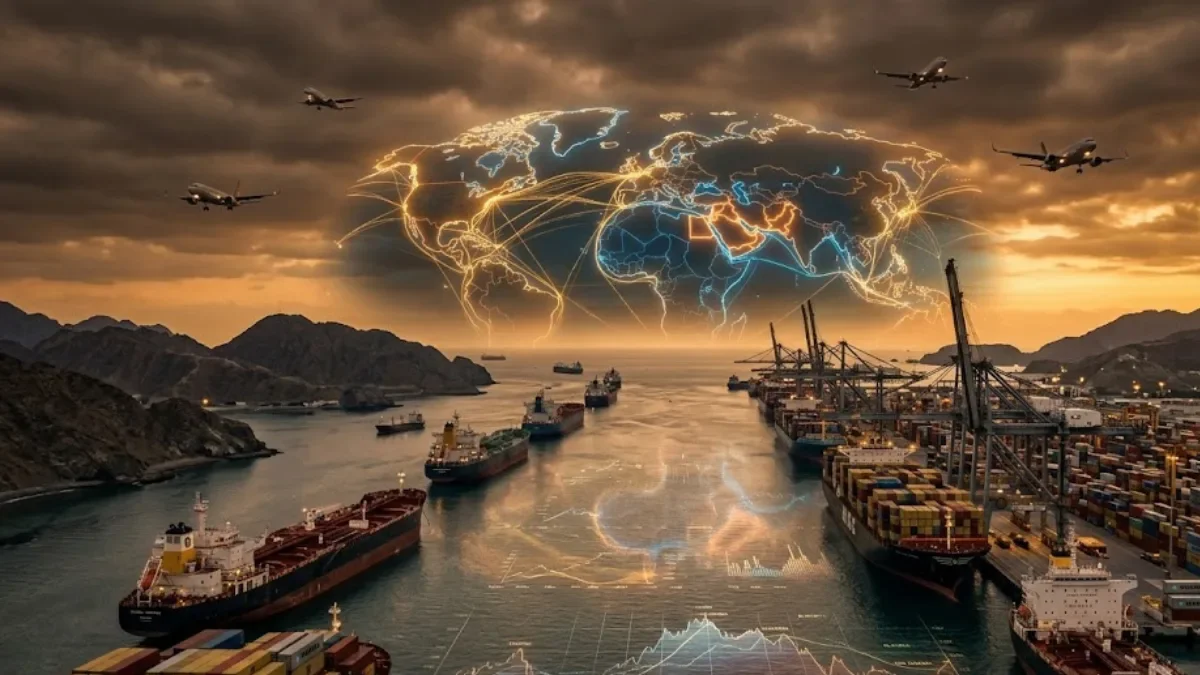
The global economy depends heavily on safe and uninterrupted trade routes. Every day, thousands of cargo ships transport oil, natural gas, food, electronics, and raw materials across oceans to keep industries and economies running. When one of these critical shipping routes comes under pressure, the effects can quickly spread across the world.
One of the biggest concerns today is the Strait of Hormuz, a narrow but strategically important waterway connecting the Persian Gulf to the Gulf of Oman and the Arabian Sea. Rising tensions in the Middle East have renewed fears about disruptions to shipping through this route, drawing attention from governments, businesses, and financial markets worldwide.
At the same time, global trade itself is undergoing a significant transformation. Many countries are reducing their dependence on traditional trade networks and strengthening regional partnerships. This shift has led to the rapid growth of South-South trade corridors, where developing nations increasingly trade directly with one another instead of relying mainly on developed economies.
Together, these developments are reshaping global commerce, supply chains, energy security, and international diplomacy.
Quick Facts
Topic | Details |
Main Issue | Rising geopolitical tensions in the Middle East |
Critical Shipping Route | Strait of Hormuz |
Importance | Major global oil and LNG transit route |
Main Concern | Potential disruption of maritime shipping |
Global Impact | Energy prices, shipping costs, supply chains |
Emerging Trend | Growth of South-South trade corridors |
Key Regions | Asia, Middle East, Africa, Latin America |
Affected Sectors | Energy, manufacturing, logistics, trade |
What Happened?
Recent geopolitical tensions in the Middle East have increased concerns over the security of shipping through the Strait of Hormuz, one of the world's most important maritime chokepoints.
Although commercial shipping continues, heightened military activity and political uncertainty have increased risks for shipping companies, insurers, energy markets, and governments.
At the same time, many countries are accelerating efforts to diversify trade routes and strengthen economic partnerships outside traditional Western-led trade systems.
Why Is the Strait of Hormuz So Important?
The Strait of Hormuz is one of the world's most strategically important waterways.
It is a narrow sea passage located between Iran and Oman that connects the Persian Gulf with the open ocean.
Every day, a significant share of globally traded crude oil and liquefied natural gas (LNG) passes through this route.
If shipping is disrupted, countries importing energy may experience:
Higher oil prices
Rising transportation costs
Increased inflation
Delays in industrial production
Pressure on financial markets
This is why developments around the Strait receive worldwide attention.
Understanding Maritime Chokepoints
A maritime chokepoint is a narrow water passage through which a large volume of international shipping must pass.
Examples include:
Chokepoint | Importance |
Strait of Hormuz | Oil and LNG exports from the Gulf |
Suez Canal | Europe-Asia trade |
Panama Canal | Atlantic-Pacific shipping |
Bab el-Mandeb | Red Sea trade route |
Strait of Malacca | Asian manufacturing and trade |
Any disruption at these locations can affect global commerce far beyond the region itself.
Background of the Current Situation
The Middle East has long been one of the world's most geopolitically sensitive regions.
Several factors contribute to recurring tensions:
Strategic competition among regional powers
Security concerns
Military deployments
Maritime security issues
Global energy dependence
Whenever tensions increase, governments closely monitor shipping activity to ensure international trade continues safely.
The Rise of South-South Trade Corridors
While geopolitical risks are increasing in some regions, another major trend is changing global trade.
Countries in Asia, Africa, the Middle East, and Latin America are expanding direct trade with each other.
This is commonly known as South-South trade.
Instead of depending primarily on North America and Europe, developing economies are building stronger regional partnerships.
Examples include:
India increasing trade with Africa and the Gulf
ASEAN regional supply chains
Middle East investments in Asia
Africa expanding intra-continental trade
Latin American exports to Asian markets
This shift reflects changing economic priorities and growing industrial capacity across developing regions.
Why Are Countries Diversifying Trade?
Several reasons are driving this transformation.
1. Supply Chain Resilience
The COVID-19 pandemic demonstrated the risks of relying on a limited number of suppliers.
Countries now seek multiple trading partners.
2. Geopolitical Uncertainty
Political conflicts can disrupt trade.
Diversification reduces dependence on any single route or region.
3. Economic Growth
Many developing economies are experiencing rapid industrialization and consumer growth.
Trading directly with these markets creates new business opportunities.
4. Regional Cooperation
Free trade agreements and infrastructure projects encourage regional commerce.
How Does This Affect Global Shipping?
Shipping companies must constantly evaluate risks.
Potential consequences include:
Longer shipping routes
Higher insurance premiums
Increased fuel costs
Additional security measures
Delayed deliveries
Even without a complete disruption, uncertainty itself can increase operating costs.
Economic Impact
The global economy is closely linked through supply chains.
Possible economic effects include:
Energy Markets
Oil price volatility
LNG market uncertainty
Higher fuel costs
Manufacturing
Industries depending on imported raw materials may experience:
Production delays
Higher costs
Supply shortages
Inflation
If transportation becomes more expensive, businesses may pass those costs on to consumers.
Impact on International Trade
Global companies are increasingly redesigning supply chains.
Many businesses now focus on:
Regional manufacturing
Multiple suppliers
Strategic inventory
Alternative shipping routes
These changes reduce risk but often increase operating expenses.
India's Role
India has become an increasingly important player in changing global trade patterns.
The country maintains strong economic ties with:
Gulf nations
Southeast Asia
Africa
Europe
North America
Because India imports a significant portion of its energy requirements, maritime security in the Middle East remains strategically important.
At the same time, India continues expanding trade partnerships across developing economies through regional connectivity initiatives and economic cooperation.
Political Impact
Governments worldwide closely monitor developments in the Middle East.
Diplomatic efforts often focus on:
Protecting shipping lanes
Maintaining regional stability
Preventing wider conflict
Supporting uninterrupted international commerce
International organizations also encourage peaceful solutions to reduce economic uncertainty.
Environmental Impact
Shipping disruptions may sometimes force vessels to take longer routes.
Possible consequences include:
Increased fuel consumption
Higher greenhouse gas emissions
Longer delivery times
Greater operational costs
This creates additional environmental and economic challenges.
Major Highlights
Rising Middle East tensions have renewed concerns over global shipping.
The Strait of Hormuz remains one of the world's most important maritime chokepoints.
Global energy markets closely watch developments in the region.
Countries are increasingly diversifying trade routes.
South-South trade is growing rapidly.
Businesses are redesigning supply chains for greater resilience.
Regional partnerships are becoming more important than ever.
Future of Global Trade
Experts believe several long-term trends may continue:
Greater regional manufacturing
Expanded trade between developing economies
Increased investment in ports and logistics
Diversified energy supplies
More resilient supply chains
Digital trade expansion
Rather than relying heavily on a few global routes, countries are building broader trade networks.
What Happens Next?
Future developments will depend on several factors:
Regional diplomatic efforts
Maritime security conditions
Global energy demand
Investment in alternative transport corridors
International trade policies
Businesses and governments are expected to continue preparing for possible disruptions while expanding alternative trade partnerships.
Key Highlights
Strait of Hormuz remains a vital global shipping route.
Middle East tensions increase uncertainty in energy markets.
Shipping companies face higher operational risks.
Countries are reducing dependence on traditional trade networks.
South-South trade is becoming an important driver of global commerce.
Supply chain diversification is now a strategic priority worldwide.
India continues strengthening partnerships across multiple regions.
Why This News Matters
This issue affects far more than international politics.
For ordinary people, disruptions to global trade can eventually influence:
Fuel prices
Food costs
Consumer goods
Transportation expenses
Inflation
Employment in export industries
Businesses must adapt to changing trade patterns, while governments work to maintain stable economic growth.
The rise of South-South trade also reflects a broader shift in the global economy, where developing nations are playing an increasingly significant role in international commerce.
Easy Explanation
Imagine that the world's economy depends on a few major highways across the sea.
The Strait of Hormuz is one of those highways.
If traffic slows or becomes risky, trucks (ships) carrying oil and other goods may face delays or higher costs.
To avoid relying on just one highway, countries are building new trade routes and increasing business with nearby developing nations.
This is called South-South trade, and it helps make global trade more flexible and resilient.
Frequently Asked Questions (FAQs)
1. What is the Strait of Hormuz?
It is a narrow waterway connecting the Persian Gulf with the Gulf of Oman and is one of the world's most important routes for oil and natural gas shipments.
2. Why is the Strait of Hormuz important?
A significant share of internationally traded oil and LNG passes through it, making it critical for global energy supplies.
3. What is a maritime chokepoint?
A maritime chokepoint is a narrow sea passage where large amounts of international shipping must pass.
4. What is South-South trade?
South-South trade refers to trade between developing countries, particularly in Asia, Africa, Latin America, and the Middle East.
5. Why are countries diversifying trade routes?
To reduce risks associated with geopolitical tensions, supply chain disruptions, and economic uncertainty.
6. How could global consumers be affected?
Higher shipping costs may eventually contribute to increased prices for fuel, food, electronics, and many imported products.
7. Why is India interested in these developments?
India depends on maritime trade for energy imports and international commerce while also expanding trade partnerships with developing economies.
8. Will global trade stop because of these tensions?
No. Global trade continues, but businesses and governments closely monitor risks and prepare alternative routes where possible.