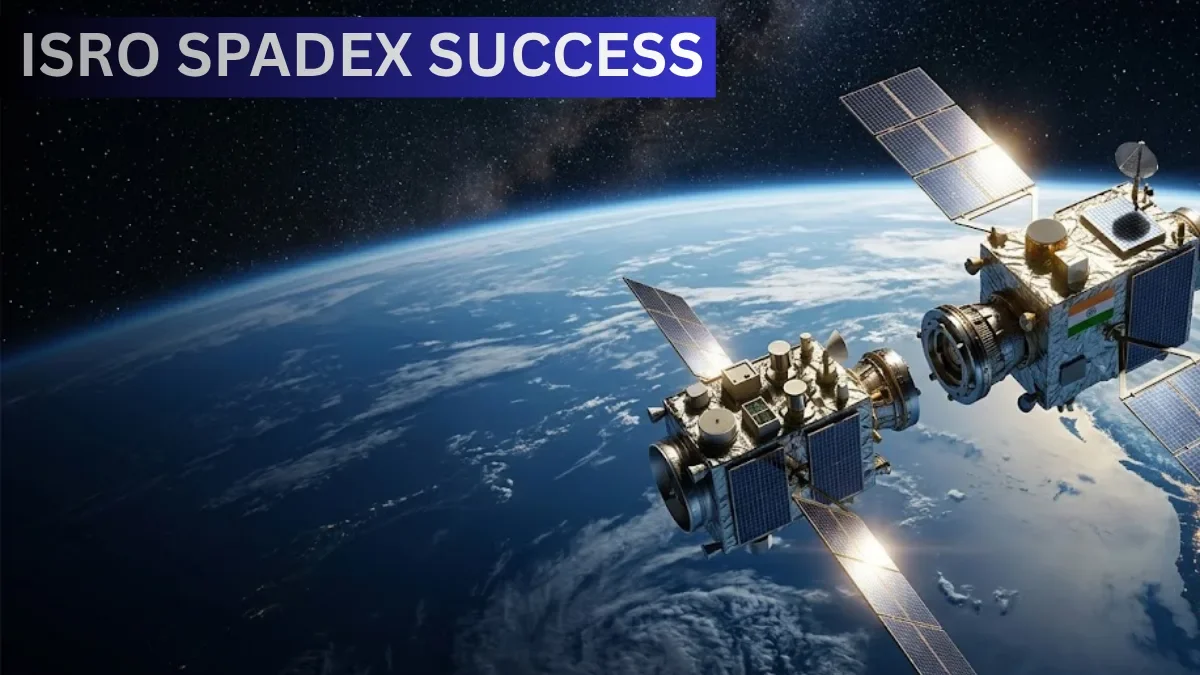
The Indian Space Research Organisation (ISRO) has marked an extraordinary leap forward in its space journey by proving the foundational technologies needed to construct an independent home in the cosmos. Through its meticulously executed Space Docking Experiment (SPADEX), India has joined an elite club of nations capable of connecting and separating two distinct spacecraft while traveling at blinding speeds in Earth's orbit.
This complex orbital maneuver, which mimics a high-stakes celestial ballet, is not just a standalone scientific demonstration. It is the direct precursor to the Bharatiya Antariksh Station (BAS), India's planned sovereign space station. By mastering the art of autonomous rendezvous, docking, and subsequent undocking, ISRO has cleared the technical bottlenecks that prevent long-duration crewed missions and the modular construction of a laboratory in space.
The space agency launched the SPADEX mission aboard the PSLV-C60 rocket, sending two specialized, 220-kilogram satellites into a 460-kilometer circular orbit. Known as the Chaser (SDX01) and the Target (SDX02), these twin crafts were commanded to separate, drift apart, track one another, and repeatedly lock back together automatically. The flawless completion of these phases validates the highly precise sensing, braking, and alignment algorithms engineered entirely by Indian scientists.
As global space dynamics shift toward sustainable presence and lunar frontiers, India's success with SPADEX secures its position as a self-reliant space power. This technological milestone changes the timeline for the first BAS module, ensuring that India's vision of an operational, human-tended space station is well on track.
Quick Facts: ISRO SPADEX Mission
Detail | Specifications & Highlights |
Mission Name | Space Docking Experiment (SPADEX) |
Conducting Agency | Indian Space Research Organisation (ISRO) |
Launch Vehicle | PSLV-C60 |
Spacecraft Involved | Twin Satellites: Chaser (SDX01) & Target (SDX02) |
Satellite Mass | Approximately 220 kg each (Modified IMS-1 bus) |
Orbital Parameter | 460 km altitude circular orbit |
Primary Objective | Autonomous Rendezvous, Docking, and Undocking |
Core Ultimate Goal | Building the Bharatiya Antariksh Station (BAS) |
What Happened: The Cosmic Handshake
The SPADEX mission unfolded as a sequence of tightly controlled orbital maneuvers designed to test how two individual systems interact in the vacuum of space. Following their initial injection into orbit, the Chaser and Target satellites performed controlled drifts to establish safe distances before initiating proximity operations.
The initial manual and semi-automated trials gave way to full autonomous docking. During these maneuvers, the Chaser satellite utilized a suite of optical, laser-ranging, and radar sensors to calculate its exact distance from the Target. Using precise thruster pulses, it trimmed its relative speed down to a crawl—measuring just millimeters per second—to prevent a catastrophic collision. The two spacecraft securely locked together, functioning temporarily as a unified satellite body.
Following the docking success, ISRO executed the equally challenging phase of undocking. Monitored via ground tracking networks across Bengaluru, Lucknow, and Mauritius, the satellites detached on the first attempt. They separated smoothly, drifted to a safe buffer zone, and maintained stable independent orbits. The subsequent rolling experiments and multi-angle re-docking attempts proved that the autonomous software could recover and connect the satellites even under varying spatial orientations.
Technical Explanation: How Space Docking Works
To understand the scale of ISRO's achievement, one must appreciate the sheer physics of orbital mechanics. Docking two objects in space is not like parking a car; it requires matching velocities while traveling at over 28,000 kilometers per hour.
Rendezvous Phase: The Chaser satellite alters its orbital altitude to catch up with the Target. Because changing altitudes alters speed in space, this requires complex mathematical pathing.
Proximity Operations: As the distance closes to a few kilometers, a specialized sensor suite (including LiDAR and infrared cameras) maps the Target's exact positioning.
Relative Velocity Reduction: The Chaser fires its retrorockets to bring the relative speed difference down to roughly 10 millimeters per second (0.036 km/h) at the moment of impact.
Latch Mechanism: A mechanical docking interface captures the Target, establishing a rigid structural and electrical connection.
Why it's difficult: A minor miscalculation in thruster firing can cause the Chaser to smash into the Target, creating dangerous space debris and destroying both multi-million dollar assets instantly.
The Roadmap to the Bharatiya Antariksh Station (BAS)
The success of SPADEX directly feeds into India's grand architecture for the Bharatiya Antariksh Station. A space station cannot be launched in a single piece because it is far too heavy and bulky for modern rockets. Instead, it must be launched piece by piece—module by module—and assembled directly in orbit.
[SPADEX Mission] ---> [Gaganyaan Crew Flights] ---> [BAS First Module Launch] ---> [Modular Expansion]
(Tech Proven) (Human Spaceflight) (Base Structure) (Full Space Station)
The technologies validated during the SPADEX runs will be utilized in several upcoming ways:
Assembling Modules: The core module of the BAS will rely on SPADEX-derived software and docking collars to latch onto subsequent laboratory and living quarters sent from Earth.
Crew Transports: When Indian astronauts fly to the BAS in future Gaganyaan capsules, their spacecraft will use this exact autonomous sequence to safely link with the station.
Cargo and Refueling: Robotic supply ships will need to dock with the BAS to replenish oxygen, water, experiments, and propellants.
Benefits and Future Implications
Mastering docking and undocking unlocks several revolutionary capabilities for India’s space ecosystem:
Satellite Servicing: Instead of abandoning expensive communication or imaging satellites when they run out of fuel or suffer minor hardware glitches, ISRO can deploy service crafts to dock, repair, and extend their operational lifespans.
Space Debris Mitigation: Autonomous docking tech allows specialized scavenger satellites to latch onto dead space junk and push it down into Earth’s atmosphere to burn up safely.
Interplanetary Staging: Deep-space human missions to the Moon or Mars will require assembling heavy spacecraft directly in Low Earth Orbit before pushing outward. SPADEX is the first mandatory step toward that capability.
Key Highlights
100% Autonomous Execution: The docking and undocking operations were carried out via onboard automated software without real-time piloting from ground stations.
Precise Control: Relative docking velocities were brought down to a razor-thin margin of 10 millimeters per second.
Ground Support Network: Operations were flawlessly monitored and supported by international ground stations located in Bengaluru, Lucknow, and Mauritius.
Direct Gateway to BAS: Validates the mechanical latching, orbital synchronization, and close-range sensory suites mandatory for constructing the Bharatiya Antariksh Station.
Why This News Matters
For ordinary citizens, a space station might feel disconnected from daily life, but its implications are sweeping. A sovereign space station ensures India does not have to rely on international platforms to conduct critical microgravity research. This research directly yields breakthroughs in advanced metallurgy, crystal growth for faster semiconductors, and specialized medical drug delivery systems that cannot be formulated under Earth's heavy gravity.
Nationally, it elevates India's strategic defense and technological standing. Economically, building a space station creates a massive localized industrial supply chain, creating high-tech engineering jobs across domestic private aerospace firms and startups.
Easy Explanation for Beginners
Imagine trying to throw a thread through the eye of a needle while riding on top of two separate supersonic jet planes. That is essentially what ISRO did in space.
Instead of airplanes, they used two satellites traveling faster than a speeding bullet. One satellite carefully tracked the other, slowed down to a gentle crawl at the very last second, and clicked into place like a Lego brick. Later, they clicked apart safely. Without mastering this "space click," you can never build a space station, because a space station requires multiple rooms to be flown up separately and clicked together in orbit. Now, India knows exactly how to do it.
also read : India's Next Frontier: Inside the 2028 Venus Orbiter Mission