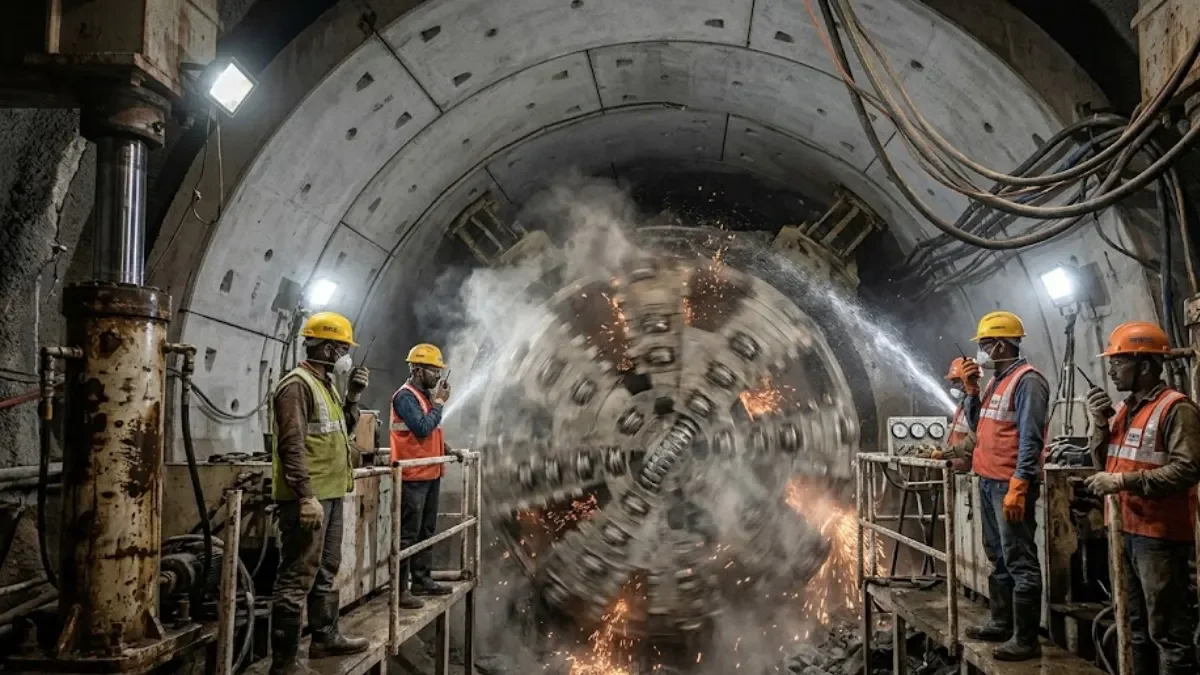
India’s ambitious high-speed rail dream crossed a momentous milestone as the nation's largest-ever railway Tunnel Boring Machine (TBM) officially commenced underground excavation in Mumbai. Operating under the management of the National High Speed Rail Corporation Limited (NHSRCL) and executed by engineering major Afcons Infrastructure Limited, the mega-machine was launched from a massive 56-meter-deep shaft located at Vikhroli.
This giant deployment marks the first time a TBM is being used for the country’s maiden high-speed rail corridor, which spans a total length of 508 kilometers between Mumbai and Ahmedabad. The machine is tasked with building a complex 6-kilometer section of the 21-kilometer underground corridor that bridges Bandra Kurla Complex (BKC) and Shilphata. This subterranean network includes India’s first-ever 7-kilometer undersea rail tunnel beneath Thane Creek.
The launch underscores the sheer scale of modern civil engineering being deployed to minimize urban disruption. Navigating deep beneath multi-storied buildings, major highways, the Mithi River, and functional metro lines, the TBM will work silently underground to carve out a path for twin high-speed tracks within a single, massive structural tube.
Quick Facts: The Mega TBM at a Glance
Feature / Detail | Specifications & Data |
Project Name | Mumbai–Ahmedabad High-Speed Rail Corridor (MAHSR) |
Executing Agency | National High Speed Rail Corporation Limited (NHSRCL) |
Contractor | Afcons Infrastructure Limited |
TBM Weight | ~3,100 tonnes (Equivalent to 500 Asian elephants) |
Cutterhead Diameter | 13.6 meters (Height of a 4-story building) |
Total TBM Length | 96 meters (Comparable to a professional football field) |
Launch Location | Vikhroli Shaft, Mumbai (56 meters below ground level) |
Tunnel Structure | Single-tube, twin-track bi-directional rail pathway |
Total Underground Package | 21 kilometers (including 7 km undersea section) |
Funding Partner | Japan International Cooperation Agency (JICA) |
Background of the Project
The Mumbai–Ahmedabad High-Speed Rail (MAHSR) corridor is India’s flagship mega-infrastructure project, designed to radically alter travel between the major economic hubs of Maharashtra and Gujarat. Estimated at a cost of ₹1.08 lakh crore, the project relies heavily on Japanese Shinkansen technology and is largely funded through a low-interest Official Development Assistance loan from the Japan International Cooperation Agency (JICA).
While 90% of the 508-kilometer alignment is built on elevated viaducts using the rapid Full Span Launching Method, entering Mumbai's dense metropolis required a completely different engineering approach. Land scarcity, dense populations, and sky-high real estate costs meant an elevated corridor through Mumbai’s core suburban zones was virtually impossible. Consequently, planners designed a 21-kilometer underground network stretching from the starting terminal at BKC to Shilphata, ensuring the bullet train enters Mumbai seamlessly without requiring mass displacement or surface demolition.
Technical Explanation: How the Mixshield TBM Works
Urban tunneling requires extreme precision to prevent the ground above from sinking—a hazard known as ground settlement. To tackle Mumbai's highly unpredictable mixed rock and soil formations, engineers selected an advanced Mixshield TBM system, which is a specialized slurry-type machine.
[ Cutterhead ] ---> [ Excavation Chamber ] ---> [ Slurry System ]
(Rotates & Crushes Rock) (Filled with Bentonite) (Pumps out debris safely)
Face Stabilization: As the 13.6-meter cutterhead rotates at up to 4 RPM, it presses against the soil. The excavation chamber behind it is filled with pressurized bentonite slurry. This fluid acts like a liquid wall, exerting counter-pressure against the earth and high groundwater levels to keep the tunnel face completely stable.
Cutting and Crushing: The cutterhead is armed with 84 cutter discs, 124 scrapers, and 16 bucket lips. Together, they grind down tough basalt rock and soft soil alike. A built-in jaw crusher breaks down larger rock chunks inside the chamber.
Debris Removal: The crushed debris mixes with the bentonite fluid and is pumped safely out of the tunnel through a closed pipeline system to a Slurry Treatment Plant located on the surface.
Simultaneous Ring Installation: As the machine moves forward at a maximum speed of 49 millimeters per minute, a robotic erector arm immediately installs precast concrete lining segments along the walls. This parallel workflow allows the machine to excavate and reinforce the tunnel simultaneously, drastically boosting safety and execution speed.
The Safety Infrastructure & Monitoring Systems
Digging a massive cavern directly underneath a thriving financial capital requires a bulletproof safety architecture. The NHSRCL has converted the Vikhroli launch site into a high-tech support hub, featuring dedicated power substations, backup generators, water treatment plants, and a ready-mix concrete plant.
To ensure that the multi-storied buildings and civic infrastructure above do not suffer from structural shifts, a web of highly sensitive monitoring instruments has been deployed along the surface alignment:
Surface Settlement Points (SSP): Placed on roads and open grounds to detect even millimeter-level shifts in soil height.
Optical Displacement Sensors & Tilt Meters: Mounted directly onto neighboring buildings to monitor real-time structural movement or leaning.
Seismographs: Constantly measuring ground vibrations and seismic waves caused by the TBM's rotation to keep impact well within safe, acceptable thresholds.
Strain Gauges: Installed inside the shaft and early tunnel layers to measure the exact stresses acting on the concrete walls.
To line the 16-kilometer TBM-driven section, a massive 11.17-hectare casting yard at Mahape is manufacturing 77,000 concrete segments. These will be assembled into 7,700 heavy structural rings. Each ring weighs a staggering 100 tonnes and is engineered as a completely waterproof structure using double-layer Ethylene Propylene Diene Monomer (EPDM) gaskets alongside hydrophilic seals.
Future Plans: What Happens Next?
The launch of the first TBM from Vikhroli opens a multi-year underground engineering phase. This initial machine will dig a 5.8-kilometer stretch toward the BKC station, a task expected to take roughly 20 months. Within the coming weeks, a second customized TBM will begin operations from the Sawli launch shaft in Ghansoli, driving a 9.7-kilometer path toward Vikhroli that encompasses the historic 7-kilometer undersea segment.
Together, the two machines are projected to advance at a combined rate of 600 meters per month. Tunnelling between Vikhroli and BKC is slated for completion by early 2027, followed by the completion of the Vikhroli-Ghansoli section by mid-2028. Once excavation wraps up, crews will shift to laying track beds, installing Japanese-grade signaling systems, and stringing overhead traction wires before entering the dynamic testing phase.
Key Highlights
Historic First: The launch marks the first deployment of a high-capacity Tunnel Boring Machine for India's bullet train network.
Record Dimensions: Featuring a 13.6-meter diameter cutterhead and weighing 3,100 tonnes, the machine stands as one of the largest rail TBMs ever used in India.
Undersea Tunnelling: The overall underground package includes a historic 7-kilometer stretch beneath Thane Creek, making it India’s first undersea rail tunnel.
Zero Disruption Tech: The advanced Mixshield slurry system uses bentonite to prevent ground settlement under Mumbai’s dense urban layout.
Heavy-Duty Lining: The tunnel will be reinforced by 77,000 concrete segments built at Mahape, utilizing double-layer EPDM gaskets to form a perfectly waterproof structure.
Why This News Matters
For ordinary citizens and daily commuters, this update signifies that India’s entry into the elite club of high-speed rail nations is rapidly shifting from a blueprint into structural reality. Once the entire corridor goes live, travel time between Mumbai and Ahmedabad will plummet from over seven hours by conventional rail to just 2 hours and 7 minutes for limited-stop trains.
Nationally, this milestone proves that Indian engineering can confidently execute world-class infrastructure projects within hyper-dense urban landscapes. The project serves as a major economic catalyst, generating thousands of highly skilled engineering and construction jobs while training Indian professionals in advanced Japanese engineering systems.
Furthermore, the environmental benefits of transitioning thousands of intercity travelers from carbon-heavy flights and personal cars onto a clean, electric high-speed rail network will drastically lower the carbon footprint of the commercial corridor for decades to come.
Easy Explanation for Beginners
Imagine you want to lay a pipe through a giant pile of sand without letting the top of the pile cave in. If you just dig a hole, the sand collapses. A Tunnel Boring Machine (TBM) solves this problem by acting like a massive, automated underground cookie cutter.
As it slowly chews through rock and soil beneath the city, it holds up the earth in front of it using a special pressurized mud liquid. While it moves forward, it automatically pieces together thick, heavy concrete blocks behind it to form a solid, permanent tube. This ensures that the buildings, roads, and rivers on the surface remain perfectly safe and undisturbed.
In this update, India has started using its largest-ever TBM to build a giant underground tunnel in Mumbai. This single wide tunnel will be large enough to host two bullet train tracks so that high-speed trains can fly in both directions simultaneously at 320 km/h, far beneath the bustling city streets.
also read : India’s EV Cybersecurity Crackdown: Everything You Need to Know