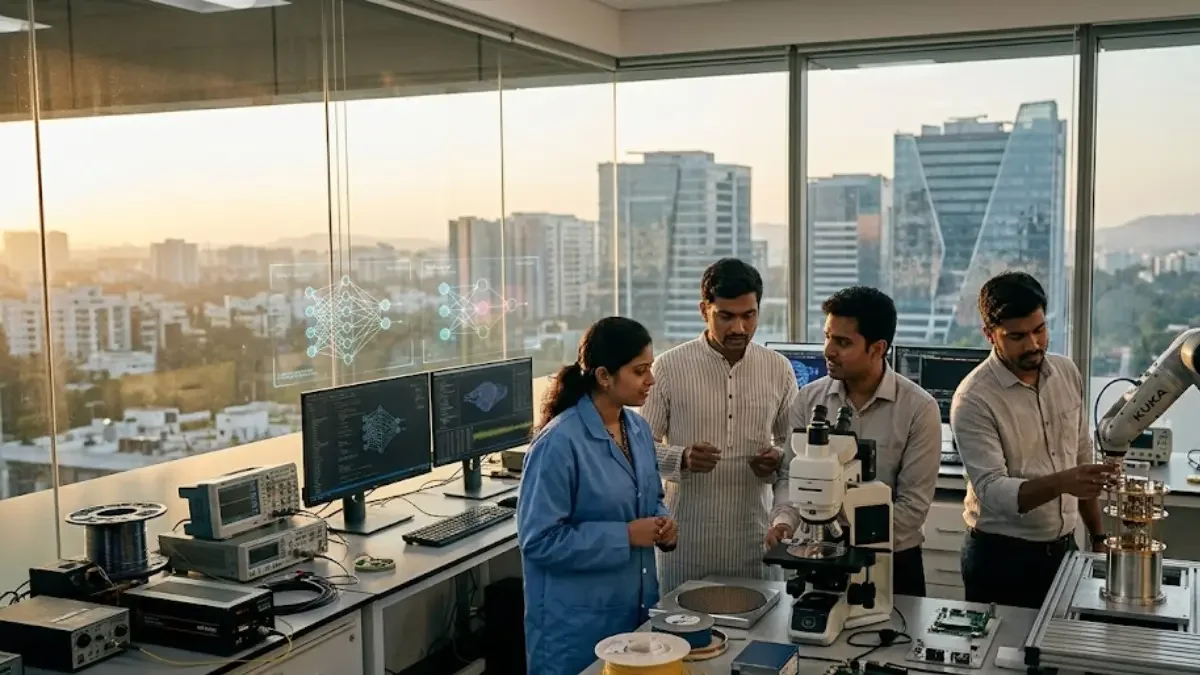
India is undergoing a profound technological evolution. For decades, the global business community viewed the nation primarily as the world's back-office—a powerhouse for software services, customer support, and IT solutions. However, a major structural shift has taken place. Today, Indian engineers are no longer just writing code for foreign applications; they are building hard science breakthroughs, custom hardware, and frontier technologies on home soil.
With more than 4,200 deep tech startups active across the country, India has firmly established itself as one of the world's primary innovation engines. The ecosystem added over 550 deep tech ventures in 2025 alone, representing a major reallocation of venture capital and public sector resources. This movement is powered by a strategic alignment between ambitious local founders, specialized global investors, and landmark government interventions designed to foster self-reliance (Atmanirbharta).
The transformation is evident on the global stage. In June 2026, the Ministry of Education showcased a curated cohort of 120 research-heavy Indian companies at the Bharat Innovates 2026 summit in Nice, France. The event officially introduced global markets to an emerging India that builds sovereign artificial intelligence, launches low-cost commercial rockets, and designs next-generation semiconductor chips. This piece explores the data, policies, and sectors driving India's deep tech boom.
Quick Facts: The Indian Deep Tech Landscape
Metric / Aspect | Current Landscape Status (2026) |
Total Deep Tech Startups | More than 4,200 active companies |
Annual Sector Funding | $2.3 billion (37% year-on-year growth) |
Key Regulatory Policy | National Deep Tech Startup Policy (NDTSP) |
New Deep Tech Definition | Recognition up to 20 years; ₹300 crore turnover limit |
Major Financial Corpuses | ₹10,000 crore Fund of Funds 2.0; ₹1 lakh crore RDI Scheme |
Primary Frontier Sectors | AI, Space Tech, Semiconductors, Quantum Computing, MedTech |
What is a Deep Tech Startup?
It helps to define the term precisely because it is frequently stretched across the tech sector. A deep tech startup is a company whose core product relies on a fundamental scientific discovery or a major engineering breakthrough, rather than a clever configuration of existing digital tools.
While a traditional tech startup might build a mobile application using standard application programming interfaces (APIs) to deliver groceries or manage corporate payroll, a deep tech startup invents entirely new battery chemistries, custom microprocessors, gene therapies, or autonomous navigation algorithms. These ventures are capital-intensive, carry high technical risk, and require multi-year development cycles before reaching commercialization.
Background and Evolution
The groundwork for this deep tech breakthrough was laid over a decade of digital transformation. The launch of the Startup India initiative in 2016 energized grassroots entrepreneurship across the country, leading to more than 2.23 lakh DPIIT-recognized startups by early 2026. However, the first wave of Indian unicorns focused heavily on e-commerce, fintech, and consumer software.
As these markets matured, local talent began looking toward harder, unresolved problems. The turning point arrived with the formulation of the National Deep Tech Startup Policy (NDTSP) framework, initiated by the Prime Minister’s Science, Technology & Innovation Advisory Council (PM-STIAC). The policy created a unified methodology to solve the unique structural challenges faced by deep tech ventures, specifically their need for prolonged validation timelines and extensive research infrastructure.
Timeline of Recent Policy Actions
July 2025: The Union Cabinet approves the Research, Development and Innovation (RDI) Scheme, introducing a massive ₹1 lakh crore corpus over six years to incentivize private sector participation in high-risk research.
February 2026: The Department for Promotion of Industry and Internal Trade (DPIIT) issues a historic gazette notification creating a dedicated "Deep Tech" category for startups, extending their operational recognition benefits to 20 years.
April 2026: The government officially launches the Startup India Fund of Funds 2.0 with a ₹10,000 crore corpus managed by SIDBI, explicitly modified to provide patient capital to deep tech enterprises.
June 2026: The Bharat Innovates 2026 summit takes place in Nice, France, securing $254.5 million in international funding commitments and cross-border research partnerships for Indian deep tech founders.
Detailed Explanation of Key Frontier Sectors
India's deep tech ecosystem is concentrated across several high-impact technology verticals, each requiring specialized capital and research capabilities.
Artificial Intelligence and Foundation Infrastructure
Artificial intelligence is the core layer running through India's deep tech map. In 2025, AI startups drew $1.22 billion across 188 funding deals. The nature of these companies has fundamentally shifted away from basic chatbots toward infrastructure-grade applications.
Indian AI innovators are currently focusing on sovereign large language models (LLMs) trained on regional languages, AI-driven drug discovery platforms, and automated machine-learning models built for industrial and defense applications.
Commercial Space Technology (Space Tech)
India's private space sector crossed an inflection point following the opening up of the sector by the Indian Space Research Organisation (ISRO). Private space tech entities have created roughly 22,000 direct jobs.
Companies like Agnikul Cosmos and Skyroot Aerospace are building small-satellite launch vehicles and 3D-printed rocket engines, while an array of downstream startups are deploying specialized earth-observation satellite constellations to track climate metrics, agricultural output, and maritime logistics.
Semiconductors and Chip Design
Under the massive ₹76,000 crore Semicon India Programme, India is moving from silicon consumption to silicon creation. The newly announced India Semiconductor Mission 2.0 has deployed a ₹1,000 crore layout for financial year 2026–27 to support startups focused on chip design tools, specialized materials, and supply-chain logistics.
As of 2026, the Design Linked Incentive (DLI) Scheme has backed 24 semiconductor design startups, giving them direct access to advanced electronic design automation (EDA) tools and chip prototyping cores.
Quantum Computing and Communications
Though quantum systems represent the longest investment horizon, development is moving systematically under India's National Quantum Mission, which features a ₹6,003.65 crore layout running through 2031. Startups in this niche are building quantum-resistant cryptography protocols, secure communications networks, and early-stage quantum software simulators to prepare industries for post-quantum computing environments.
Technical Transformation: Rewriting the Startup Rules
The government's February 2026 gazette notification completely overhauled the legal framework for research-driven enterprises to better suit their unique development cycles.
Traditional Startups:
[ Incorporation ] ──► [ 1-2 Year Dev ] ──► [ Scale / Turnover Limit: ₹200cr ] ──► (Ends at Year 10)
Deep Tech Startups (New 2026 Rules):
[ Incorporation ] ──► [ 5-7 Year Lab/TRL R&D ] ──► [ Commercialization ] ──► [ Turnover Limit: ₹300cr ] ──► (Extended to Year 20)
As the diagram shows, deep tech ventures operate on a fundamentally extended timeline compared to typical consumer software companies. Under the revised guidelines, the operational age limit for a deep tech startup to receive official state recognition and regulatory exemptions has been extended from 10 years to 20 years.
Furthermore, the maximum annual turnover threshold has been raised to ₹300 crore (compared to ₹200 crore for general startups). This change ensures that research-heavy companies can spend up to a decade in the laboratory developing intellectual property without losing access to critical government seed grants, tax exemptions, and public procurement opportunities.
Economic and Strategic Impact
The economic ripple effect of deep tech innovation is vastly different from traditional digital business models. Every dollar invested in frontier areas like space tech or hardware manufacturing creates a significant economic multiplier, driving high-value employment across downstream electronics, metallurgy, precision machining, and specialized software development.
Strategically, the domestic development of deep tech ensures national sovereignty over critical infrastructure. By building indigenous semiconductor design IP, home-grown cybersecurity protocols, and autonomous defense hardware, India reduces its reliance on foreign technology supply chains, protecting its economic security and digital assets from geopolitical disruptions.
Key Challenges Facing the Sector
Despite substantial progress, Indian deep tech founders face several unique institutional hurdles:
The Funding 'Valley of Death': While early-stage seed capital is readily available through government grants, transitioning from a proven laboratory prototype to full-scale commercial manufacturing requires substantial Series A and Series B capital.
The Need for Patient Capital: Traditional venture capital funds operate on five-to-seven-year return horizons. Deep tech innovations typically require seven-to-ten-year horizons, calling for institutional investors willing to back long-term research.
Access to Testing Infrastructure: Building advanced hardware requires access to specialized testing facilities, wind tunnels, cleanrooms, and nanofabrication labs. The government is addressing this by launching ATRI Centres to help startups move their prototypes from Technology Readiness Level 4 (TRL 4) up to commercial-grade TRL 7.
Key Highlights & Takeaways
Structural Evolution: India is housing more than 4,200 deep tech startups in 2026, transitioning from an offshore IT delivery hub to a creator of core breakthrough engineering.
Capital Accel: Deep tech sector funding jumped 37% year-on-year to reach $2.3 billion, defying broader global venture capital caution.
Policy Extension: New regulatory rules extend deep tech startup recognition to 20 years and increase the turnover cap to ₹300 crore to accommodate prolonged research cycles.
Government Backing: Massive public funds, including the ₹1 lakh crore RDI Scheme and the ₹10,000 crore Fund of Funds 2.0, are providing long-term patient capital.
Global Footprint: Initiatives like Bharat Innovates 2026 are connecting local innovators with international capital networks, drawing over $254 million in immediate funding interest.
Why This News Matters
For the everyday citizen, the rise of deep tech startups is a vital economic shift. It means the premium jobs of tomorrow will be created within India, allowing top-tier local scientists, researchers, and engineers to build globally competitive products without needing to move abroad.
On a broader scale, deep tech directly addresses real-world societal issues. The innovations coming out of these startups include low-cost satellite imaging to assist farmers with precision agriculture, AI-driven medical devices capable of detecting diseases early in remote villages, and new clean-energy battery systems designed to reduce urban pollution. It represents an evolution toward technology that changes lives.
Easy Explanation for Beginners
Think of standard technology startups like building a new type of restaurant: they use familiar ingredients (like existing cloud storage, basic programming languages, and mobile apps) to deliver a new experience or menu item to customers.
Deep tech, however, is like inventing a whole new way to grow food or creating an entirely new type of cooking appliance that never existed before. Because these companies are working with hard science—like building actual rocket engines, designing physical computer microchips, or working with quantum mechanics—they cannot just launch a product in a couple of weeks. They need years of laboratory research, testing, and specialized funding before their creations are ready for the public. India's latest policies are designed to give these inventors the time, funding, and laboratories they need to build things safely.
Frequently Asked Questions (FAQs)
1. What qualifies an Indian company as a "deep tech" startup?
A deep tech startup is one whose product or service relies entirely on a scientific breakthrough or a major engineering innovation. Their core value comes from unique intellectual property (IP) and long-term research, rather than just building an app on top of existing software.
2. How did the government rules change for deep tech startups in 2026?
The government doubled the turnover eligibility limit to ₹300 crore and extended the total period of official startup recognition up to 20 years from the date of incorporation, allowing research-intensive firms more time to mature.
3. What is the Startup India Fund of Funds 2.0?
It is a state-supported financial initiative featuring a ₹10,000 crore corpus. It invests in SEBI-registered Alternative Investment Funds (AIFs), which then distribute long-term risk capital specifically targeted at deep tech and frontier tech startups.
4. What was the purpose of the Bharat Innovates 2026 event?
Organized by the Ministry of Education in Nice, France, the event showcased 13 frontier technology sectors from India to global investors and policymakers, securing over $254.5 million in strategic funding and collaboration commitments.
5. Why do deep tech startups require "patient capital"?
Because they are developing entirely new hardware, chemical compounds, or complex algorithms, these companies can take five to seven years just to finish prototyping and testing before they earn any revenue. They need investors who are comfortable waiting longer for financial returns.
6. What role does ISRO play in India's space tech startup boom?
ISRO has opened up its testing infrastructure, launch pads, and historical technical data to private startups. This collaboration allows private space firms to safely test and deploy their custom rockets and satellites.
Conclusion
India’s deep tech startup movement represents a significant shift from digital replication to core frontier innovation. By constructing a robust ecosystem supported by long-term public funding, extended regulatory cushions, and dedicated research corridors, the nation is positioning its young innovators to tackle some of the world's most complex challenges. As these 4,200+ ventures transition their products from laboratories to commercial markets, they are creating a future where India doesn't just participate in global technology—it actively shapes its trajectory.